
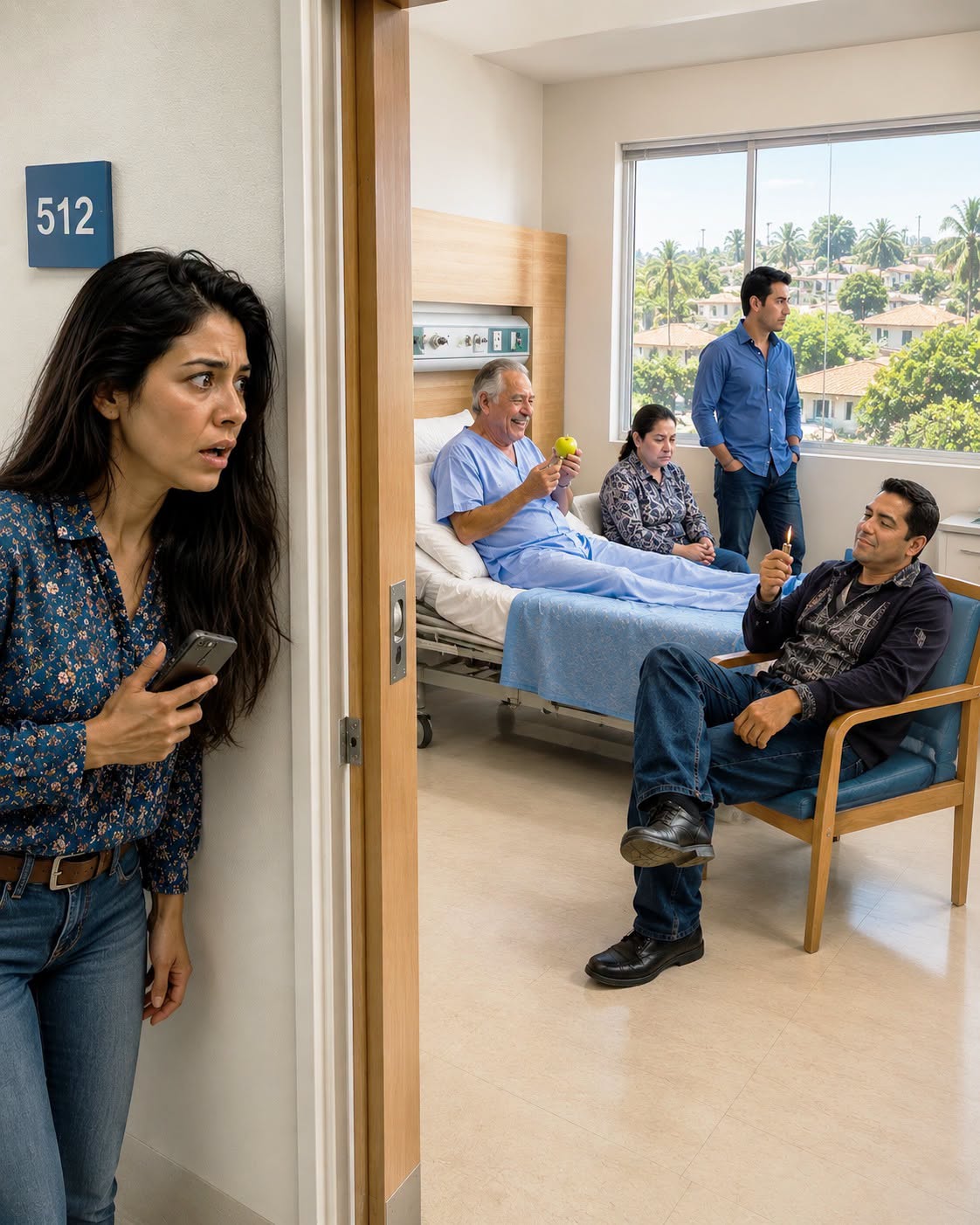
My husband asked me for 300,000—sobbing—because his dad was dying. And he FORBADE me from setting foot in the hospital. He knew my PIN better than I did.
It was 12:40 a.m. I had opened the fixed-term account just a month ago at the downtown branch, and I hadn’t written that PIN down anywhere.
Not even my mom knew it.
Rodrigo rattled it off—sniffling—without getting a single digit wrong.
“A stroke, my love. He’s intubated. We’re losing him.”
And then, in a lower voice:
“You stay home. Don’t come. You couldn’t bear to see him like this.”
I hung up. My mouth went instantly dry.I didn’t transfer anything. I grabbed the keys with my left hand because my right one wouldn’t respond.
And from the fifth-floor hallway, I heard my father-in-law—the one who was intubated—laughing with his mouth full of apple. 😱😮⚠
Five years of marriage. A full five years.
On our wedding day, my dad gave me away with red eyes and told him, “Take good care of her, son.” Rodrigo said yes, wearing a look that I believed completely.
My mom used to say I’d hit the jackpot with that son-in-law.
I gave him the password during our first year. Nobody even asked me for it.
What’s the point of getting married if you’re going to hide your money? That’s what I thought.
I put the business in my name because his credit rating was bad. I was happy to sign and help him out.
On paper, I’m the owner. The legal representative. The one liable for the debts if the whole thing goes under.
The house where I grew up is in my name, too. My dad left it to me before I got married.
It’s the only thing in this life that’s still mine.
The only person in that family I really cared for was Doña Mati, my mother-in-law. She taught me how to make mole for Rodrigo. She used to call me “daughter” as if she truly meant it.
When I was sick, she’d bring broth up to my room without me even asking.
One Sunday, while the two of us were washing dishes alone, she said something quietly, without looking at me.
“Always keep something of your own, mija. An account, a key—whatever it is.”
And then, even more softly:
“Even if you love him with all your soul.”
I thanked her and kept rinsing the dishes. Just things older women say.
In January, I got an additional credit card for him. For his blood pressure medication, he told me—and I didn’t even ask how much he was spending.
At the front desk, the young woman looked up his name twice.
“Genaro Ruvalcaba. Fifth floor, standard room.”
Standard room. Not intensive care.
In the elevator, I counted five floors, yet I don’t remember a single one.
The door to room 512 was ajar. Ten centimeters—no more.
And everyone was inside.Don Genaro sat perched on the edge of the bed, looking pink-cheeked, peeling another apple with a small pocketknife. Doña Mati sat quietly beside him, wearing her sweater indoors. Rodrigo leaned against the window, hands in his pockets. And Beto, my brother-in-law, sprawled in the visitor’s chair, twirling a lighter on his finger.
“Dad, do you really think she swallowed it?” Beto asked.
“Of course she swallowed it. She believes whatever Rodrigo says.”
“Five years, Dad.”
“Dumber than a mule.”
A lump formed in my throat. I couldn’t even swallow.
Doña Mati sighed.
“Oh, Genaro. The girl is a good person…”
“Good for what?” he cut her off, not looking at her. “She still hasn’t put the house in our name.”
The small knife kept circling the apple.
“Rodrigo needs to get her to sign the mortgage papers. And then, out on the street. What use is she to us after that?”
He turned to look at his wife.
“And don’t act so saintly. Your chemo on Monday is being paid for with her card. If this doesn’t work, you’re left without treatment.”
Doña Mati pulled her sweater tighter and said nothing more.
Rodrigo hadn’t spoken all night. Then he spoke—calmly, like someone announcing it was going to rain.
“Keep your voices down. I’ve already had the house appraised.”
“For how much?”
“Almost three million.”
Three million. My dad’s house. The rooms he’d roofed using his severance pay, hauling the cement up to the roof when he was sixty years old.
“I’ll tell her the company needs capital urgently. She signs the mortgage with me, and we wrap it all up.” A month, two at most.
Beto burst out laughing.
“Brother, you’re a hell of an actor. I couldn’t stand five years of faking affection for someone you’ve been done with since the wedding.”
Five years sleeping next to a stranger.
I already had my cell phone pressed to my ear.
I dialed the customer number wrong three times. Three. On the fourth try, my voice came out steady.
“I want to FREEZE all my accounts. Today, right now, this very moment.”
The young woman asked if I was sure.
“The personal ones and the joint account. And report all my cards as lost. All of them.”
I hung up. I wiped my face with my sweater sleeve. I took one deep breath—all the way down.
And I texted Rodrigo, weighing every word: “I’ve made the transfer, my love. Don’t worry about it. Give your dad a kiss for me.”I hit send and walked to the parking lot on stiff legs.
They could wait forever. This time, I was the one taking action.
Once in the car—my heart eerily still, frozen by sheer rage—I got a message from Doña Mati.
No text. Just a photo.
A folded medical prescription, showing her full name and a diagnosis I wouldn’t wish on anyone.
Don Genaro’s bed was free of sickness. Hers wasn’t.
The cancer was hers, and it was real. And Monday’s chemo was to be paid for with the very card I’d reported lost just ten minutes ago.
I stared at that photo without blinking, the engine running and the clutch disengaged.
“Always keep something for yourself, mija.”
She hadn’t been giving advice. She’d been warning me.
She knew. She’d known since before the wedding—through every dinner, every snide remark from her husband. And she’d stayed silent every single time.
She’d defended me tonight, sure—but only half-heartedly. Only when she had no other choice.
Because I was the only lifeline she had to keep from drowning in that family, too.
I have two messages typed out on the screen, my finger hovering over both.
One freezes everything—down to the last cent—leaving that whole family to rot empty-handed. Her included; she used me just like they did, only she did it with homemade broth and the word “mija.”
The other releases just one thing.
The bank opens at nine. And on Monday at seven in the morning, someone will be sitting in that chair, waiting for an IV drip that might—or might not—arrive, depending on what I press right now:
I didn’t send either one.Dawn found me still in the parking lot, the engine running and my cell phone hot in my hand. At 6:40, a message arrived from Rodrigo: “We’re heading home now. My dad is stable. Thanks for everything, my love.”
I washed my face in an Oxxo restroom. I remember the smell of burnt coffee and the woman at the counter asking if I was okay.
I told her I was.
Rodrigo arrived at a quarter past seven. He was wearing the same shirt. He hugged me from behind while I put the water on for coffee, and he breathed in the scent of my hair, just like five years ago.
“Did the transfer go through yet? The hospital is asking for a deposit.”
“It’s probably processing. It takes longer on weekends.”
“Yeah. That must be it.”
He went to take a shower. I stood there motionless, watching the water boil.
At 7:02, before he came out, I received an email from the bank. An appointment reminder. Thursday the 12th, eleven in the morning, Notary Office 43. Signing of a mortgage guarantee.
In my name. Scheduled three weeks ago.
I never requested that appointment.
On Saturday at nine, I was standing outside the branch, waiting for them to roll up the security shutter. The bank officer’s name is Paola. She’s known me since I opened the company account.
I asked her to print everything out for me. Everything—as if I knew nothing about it.
It took forty minutes.
The company registered in my name owes one million eight hundred and sixty thousand pesos. I am the joint and several guarantor. I signed that back in 2021, on a sheet of paper he handed me along with ten others—in the trunk of the car, using a bank pen.
“If this isn’t paid, ma’am, your personal assets are liable.” My personal assets consist of a house. The house where my dad taught me to ride a bike in the yard.
Paola lowered her voice for what came next.
“There’s something here. Her account shows balance inquiries made via the app every single day—from a different device.”
“Since when?”
“Since the day she opened it.”
And that’s when I remembered the PIN.
Six numbers. 080719.
July 8, 2019. The day I buried my dad.
It poured rain that day, and there was only one umbrella. Rodrigo held it over my head throughout the mass, and at the cemetery, he wiped my face with his jacket sleeve and told me that he was my family now.
I never told anyone the code. There was never any need.
I left the bank clutching the folder to my chest and sat on the curb like a beggar, the papers on my knees, and I didn’t cry. I just sat there for a while, watching the cars go by.
What really got to me wasn’t the 1.8 million.
It was that she chose that date. That she had it written down.
I didn’t sleep at my own house that night. I went to my dad’s place—the one that’s still empty, the one they were going to mortgage on Thursday.
It still smells like him there. Like stale cigarettes and Fabuloso.
I turned on the kitchen light at five in the morning because I couldn’t stand lying in bed anymore. I put water on to boil for café de olla—with the piloncillo and cinnamon, just the way Doña Mati taught me.
The notebook was in the pantry.
A lined notebook—the kind you get at the stationery store—with the mole recipe written in my handwriting. She had dictated it to me. I’d offered to take a picture of it, but she wouldn’t let me.
“By hand, mija.” What is written by hand is never lost.
It was a Sunday in February. The third. I remember because it rained out of season, and she arrived wearing her sweater and didn’t take it off all afternoon.
That day, we spent six hours on that mole. Six. Bending my arm to avoid getting burned, adding the chocolate little by little, while she sat on the stool because she said she couldn’t stand up anymore.
And that same afternoon, while washing the dishes—without turning to look at me—she spoke to me about saving something of mine.
I thought she was talking about life in general. I thanked her and kept rinsing plates.
In July, I opened the fixed-term account. Three hundred thousand. Everything I had.
It was because of that phrase. Nothing but that phrase.
There were things about Doña Mati that kept turning over in my mind during those three days—things I couldn’t quite make sense of.
How she never let anyone take her to chemo. Not me, not her son, not Beto. She would go alone on the bus on Mondays at seven-thirty, carrying her shopping bag. She said she didn’t want anyone to see her vomiting—that it wasn’t something you showed your family.
How, after February, she stopped coming to Sunday lunch. She would send tamales with Beto, along with a note. Don Genaro would say she was feeling weak.
And how the supplementary card I’d gotten for her in January always showed the same charge—eight hundred and fifty pesos—on the fifth of every month, listed as “services.” I used to pay the bill without checking it. She had told me it was for her blood pressure medication. You don’t go around asking an elderly lady to account for eight hundred and fifty pesos.
Right now, I don’t know what hurts the most out of everything I’m telling you. Honestly, I don’t know.
But of those three days, the one that won’t leave my mind is the Sunday.She called me at five in the afternoon. Just to tell me she was outside her house, sitting on the curb.
There she was, on the entryway step, wearing a brown sweater with her hands clasped between her knees. In August. In that heat.
I sat down beside her. We didn’t hug.
“I know you were in the hospital,” she said.
“How do you know?”
“Because I know my son. And last night, he was calm.”
A car stopped at the corner with loud music playing, and we waited for it to leave.
“Five years, Doña Mati.”
“Yes.”
“You knew.”
“Since before the wedding.”
That’s how she said it. Without embellishment, without crying, looking down at the curb.
“His father said it right here in this kitchen. That if the girl had a house, it was worth it. I was standing by the stove.”
“And you didn’t say anything?”
“I did. Once.”
She pulled up the collar of her sweater.
“In ninety-eight, I said something too. And I went two weeks without being able to chew on this side.”
I stayed quiet. You could hear the gas hissing from the sweet potato vendor’s cart.
“I watched him grow up seeing his father do this to me,” she said. “And I didn’t leave.”
That was when her voice cracked—just a little, though, like someone holding back a sneeze.
“When you said ‘I do’ in the church, I had my mouth open, ready to shout at you. I swear it on my mother’s life. But then I just drank the holy water like nothing was wrong.”
“He used to call me ‘daughter’.”—And I was sorry.
—It’s no use, Doña Mati.
—I know it isn’t.
I asked her about the money. I asked why she’d sent me the photo of the prescription if she wasn’t asking for help.
She took a moment to answer.
—So you’d know that the sick person in that room wasn’t the one lying in the bed.
I told her the card would be cleared by Monday, that she should go to her treatment without worrying.
And that was when she grabbed my wrist.
—Don’t send me anything, Karla. Not a single peso.
—Doña Mati…
—Not a single peso. We’ve already taken enough from you.
She squeezed my wrist twice and let go. She went into her house without saying goodbye and shut the front gate with her foot.
I sat on the curb until nightfall, thinking about how pride and decency aren’t the same thing, and how that woman had only one of the two left.
That night, at eleven-forty, I sent the message.
Just one, like I said.
I activated only the supplementary card in Matilde Ruvalcaba’s name, with a limit of twelve thousand pesos, exclusively for hospital use. Everything else remained frozen. The fixed-term deposit, the joint account, his cards. Everything.
I paid for the chemo for the woman who had stayed silent for five years while I was being sold off.
Let anyone judge me who wants to. I judged myself all night long.
At midnight, I called an on-call locksmith and paid him double to come out at that hour. We changed the lock on the front gate of my dad’s house.
At one o’clock, I packed Rodrigo’s clothes into shopping bags. I didn’t break a thing. I folded everything—even the socks—because that’s just how I am, and I’m not going to change that at forty-one.
At two o’clock, I messaged the lawyer Paola had recommended to cancel Thursday’s appointment.
And at three, I remembered that in five years, I never knew how much my husband earned.
On Monday, I went to the clinic. Not to look for her. Just to make sure the card had gone through, because I don’t quite trust those things.
The young woman at the window looked up the surname twice.
“Ruvalcaba, Matilde. Nothing shows up here for today.”
“Her chemo, miss. The Monday one.”
She turned the screen toward me, so I could see for myself.
“Ma’am, she signed a form discharging herself against medical advice. She hasn’t been here since February 3rd.”
February 3rd was the Sunday of the mole.
I had to steady myself against the counter. I asked for a chair, and they gave me one.
Seven months. Seven months of Mondays at seven-thirty, with her shopping bag, getting on the bus all by herself.
That afternoon, I called the bank to ask about the eight-hundred-and-fifty-peso charge from the fifth.
Rentería & Associates Law Firm. 118 Morelos Street, above the stationery store.
