
PART 2 — THE THING IN THE PORCELAIN BOWL
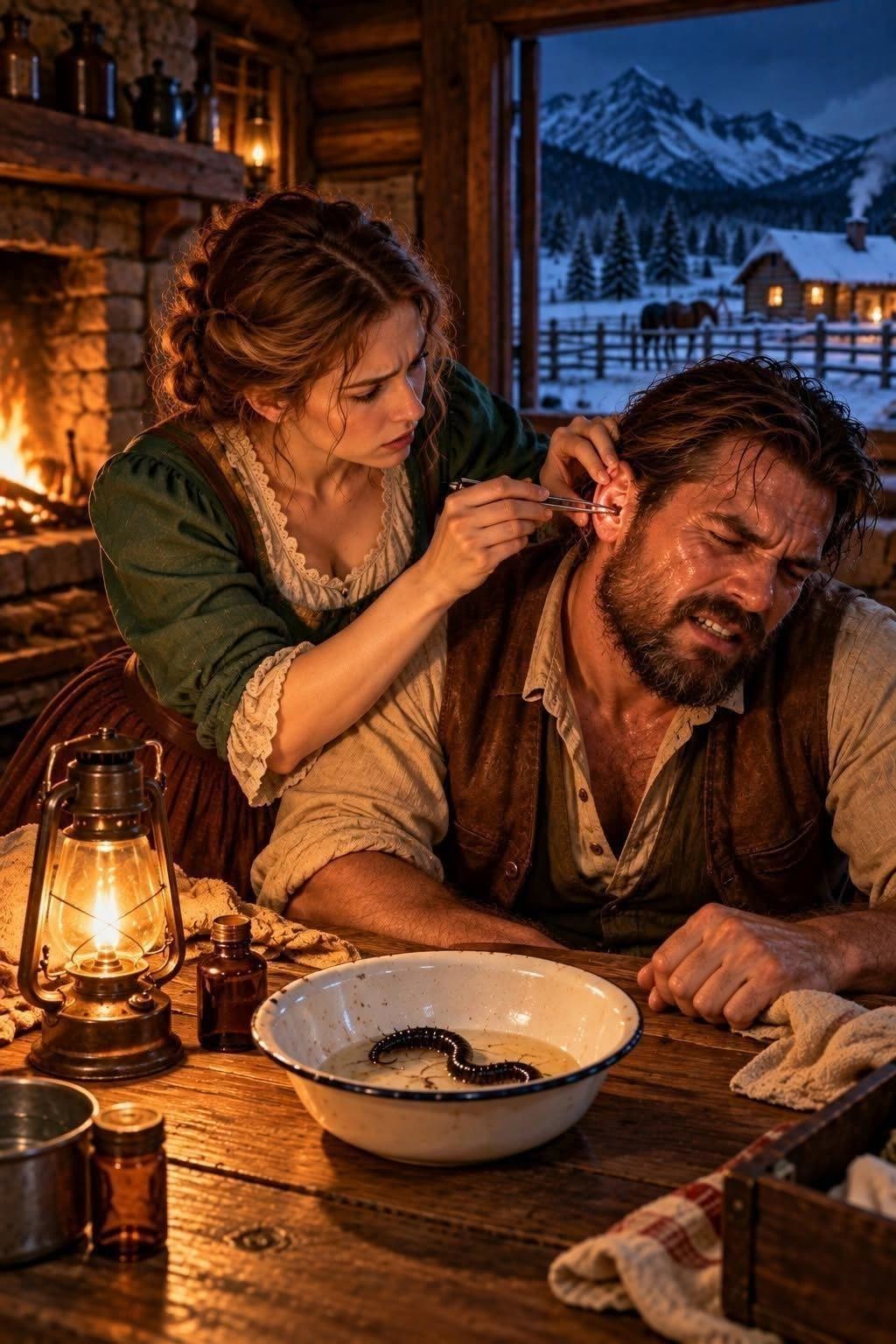
The thing in the porcelain bowl began to move.
Rosalie nearly dropped the tweezers.
For several seconds, neither she nor Gideon moved.
The cabin seemed to shrink around them. Wind pressed against the windows, rattling the panes in their wooden frames, while the fire behind Gideon sent long shadows crawling across the floor.
Rosalie lowered the oil lamp.
The black object was no longer than the first joint of her finger.
At first she had thought it was some kind of insect.
But insects did not look like that.
One end was dark and hardened, almost metallic beneath the blood and wax coating it. Attached to it was a thin curl of something pale and fibrous.
Gideon leaned closer.
His face had gone strangely still.
Rosalie reached for the pencil.
Do you know what this is?
He read the question.
Then shook his head.
But she saw hesitation in his eyes.
“You do,” she whispered, forgetting for a moment that he could barely hear her.
Gideon looked away.
Rosalie touched his sleeve.
When he met her gaze again, she pointed at the notebook.
Tell me.
His hand trembled as he took the pencil.
I have seen something like it before.
Rosalie stared at the sentence.
Where?
Gideon did not answer immediately.
Instead, he stood.
The movement nearly sent him back into the chair. Rosalie caught his arm, but he gently steadied himself and walked toward the bedroom.
He knelt beside an old cedar chest beneath the window.
Rosalie had noticed it before. Unlike everything else in the cabin, the chest was locked.
Gideon reached beneath his shirt and pulled out a thin leather cord.
A small brass key hung from it.
He unlocked the chest.
Inside were neatly folded shirts, several documents wrapped in cloth, an old revolver, and a small wooden box.
Gideon lifted the box.
He carried it to the table.
Then he opened it.
Rosalie forgot to breathe.
Inside lay another black fragment.
It was nearly identical to the thing she had just pulled from his ear.
Gideon had found the first piece when he was seventeen.
He explained everything in writing.
The process was slow.
He would write a few sentences, pause, rub his temple, then continue.
Rosalie sat across from him while the storm deepened outside.
When I was nine, I became very sick.
She looked up.
Gideon continued.Fever. Pain in my ears. I remember screaming. Afterward I could barely hear.
Rosalie waited.
My father took me to Dr. Bell.
The name meant nothing to her.
Gideon noticed.
He was the doctor in Coldwater before Dr. Whitcomb.
What did he say happened?
Infection.
Gideon’s pencil stopped.
Then he added:
My father said it was an accident.
Rosalie frowned.
Those are different things.
Gideon gave the faintest nod.
That contradiction had clearly troubled him for years.
When he was seventeen, another terrible episode of pain had struck him while repairing a fence. Something small had fallen from his ear afterward.
The black fragment.
His father had taken one look at it and gone pale.
Then he had ordered Gideon never to speak of it.
Rosalie read the sentence twice.
Why?
Gideon wrote:
He said some doors should stay closed.
Rosalie looked toward the bowl.
“What kind of father says that?”
Gideon could not hear the words clearly, but perhaps he understood her expression.
His face softened.
He reached across the table and placed his hand beside hers.
Not touching.
Just close.
It was the nearest they had come to tenderness.
Rosalie stared at the space between their fingers.
Eight days ago, she had believed this man would be another prison.
Instead, he had given her a room, privacy, food, safety—and now a secret he had apparently shared with no one else.
She turned the notebook toward herself.
We should see a doctor.
Gideon’s expression closed immediately.
No.
Why?
Doctors already decided.
Years ago.
No.
Rosalie studied him.
Then she wrote more carefully.
You trusted me tonight.
His eyes moved over the words.
Trust me tomorrow.
Something changed in his face.
The resistance did not disappear, but it weakened.
Finally, Gideon nodded.
Dr. Samuel Whitcomb lived above his surgery on the eastern side of Coldwater.
The following morning, Gideon harnessed the horses while Rosalie wrapped the strange object in clean cloth and placed it inside a small tin.
Snow had stopped falling, leaving the countryside buried beneath a brilliant white silence.
During the wagon ride, Gideon glanced toward her repeatedly.
Rosalie finally opened the notebook balanced between them.
What?
He wrote beneath it.
You could have left.
She frowned.
When?
Last night.
Rosalie almost smiled.
And gone where?
Gideon’s expression became serious.
He took the pencil again.
Anywhere you wanted.
The answer unsettled her.
Not because it frightened her.Because she believed him.
Gideon had paid fifty dollars to her father, yet he apparently did not consider that money a purchase.
She wrote:
Why did you agree to marry me?
For the first time since she had met him, Gideon seemed genuinely uncomfortable.
He stared ahead at the road.
Rosalie waited.
Finally, he wrote only:
Your father asked.
That was not an answer.
She underlined the question.
Gideon looked at it.
Then at her.
Something almost like amusement appeared in his eyes.
He wrote:
You are stubborn.
Rosalie added:
You are avoiding me.
This time, Gideon smiled.
It transformed him.
The severe lines around his mouth softened. For one brief moment he did not look like Coldwater’s mysterious rancher.
He looked like a man who had forgotten he was allowed to be happy.
Rosalie found herself smiling too.
But he still did not answer.
Dr. Whitcomb was younger than Rosalie expected, perhaps forty-five, with spectacles that constantly slipped down his nose.
He examined Gideon’s ear for nearly twenty minutes.
His expression gradually changed.
Confusion.
Concern.
Then disbelief.
He examined the object Rosalie had removed.
“Where did you say this came from?”
“His ear.”
Whitcomb turned it beneath a magnifying glass.
“And you removed it yourself?”
Rosalie nodded.
“With sewing tweezers.”
The doctor slowly looked at her.
“I would normally give you a lecture about attempting medical procedures without training.”
Rosalie folded her hands.
“But?”
“But I suspect you may have saved him from a much worse infection.”
Gideon watched their faces, unable to follow the conversation.
Rosalie immediately wrote a summary for him.
Whitcomb noticed.
Something sympathetic passed through his expression.
He returned to the fragment.
“This isn’t alive.”
Rosalie blinked.
“It moved.”
“I believe what you saw was tissue attached to it contracting after removal.”
Relief washed through her so suddenly that she had to sit down.
Not alive.
Thank heaven.
“But what is it?”
Whitcomb hesitated.
“I don’t know.”
He scraped away some of the residue.
Metal appeared beneath.
Rosalie leaned forward.
“A piece of metal?”
“Possibly.”
Gideon read her lips imperfectly.
He wrote quickly.
Metal?
Rosalie nodded.
Whitcomb examined Gideon’s ear again.
“There is considerable scar tissue. Old scar tissue.”
“How old?”
“Years. Possibly decades.”
Rosalie’s stomach tightened.
“And his deafness?”
Whitcomb removed his spectacles.
“I cannot say without better instruments. But I can tell you something.”
He glanced toward Gideon.“I don’t believe an ordinary childhood infection explains everything I’m seeing.”
Rosalie translated the statement into the notebook.
Gideon read it.
His jaw tightened.
For twenty-nine years, people had told him there was nothing to investigate.
Now a doctor was telling him the opposite.
Whitcomb walked toward a cabinet.
“Who treated him originally?”
“Dr. Bell.”
The glass bottle in Whitcomb’s hand stopped moving.
Rosalie noticed.
“You knew him?”
Whitcomb carefully returned the bottle to the shelf.
“Everyone knew Elias Bell.”
“Was he a good doctor?”
A long silence followed.
“That depends on whom you ask.”
Outside the surgery, Rosalie caught Whitcomb before Gideon reached the wagon.
“What aren’t you telling us?”
The doctor looked toward Gideon.
“Mrs. Rook—”
“Rosalie.”
Whitcomb sighed.
“Dr. Bell left Coldwater suddenly in 1871.”
“That was around the time Gideon became ill.”
“Yes.”
“Why did he leave?”
“No one knows.”
Rosalie waited.
Whitcomb lowered his voice.
“There were rumors.”
“What rumors?”
“That Bell had been treating children with methods other doctors considered experimental.”
Rosalie’s skin went cold.
“What kind of methods?”
“I don’t know.”
“Then how do you know they existed?”
Whitcomb looked uncomfortable.
“Because my father was a physician too.”
That surprised her.
“He kept records. Letters between doctors. Complaints.”
“Do you still have them?”
Whitcomb looked toward his upstairs rooms.
“Somewhere.”
“Can we see them?”
His hesitation was answer enough.
Rosalie stepped closer.
“Dr. Whitcomb, my husband has spent most of his life believing his suffering was unavoidable. If someone knew differently, he deserves the truth.”
Whitcomb studied her for several seconds.
Then he nodded.
“I’ll look.”
They stopped at the general store before leaving town.
Rosalie needed flour, salt, and lamp oil.
Gideon waited outside with the wagon.
The moment Rosalie entered, conversation quieted.
She pretended not to notice.
Mrs. Caldwell, the shopkeeper’s wife, approached the counter.
“How is married life?”
“Well.”
The older woman’s eyebrows lifted.
“Well?”
Rosalie placed flour on the counter.
“Yes.”
“Gideon isn’t… difficult?”
Rosalie understood what she meant.
“No.”
Mrs. Caldwell seemed almost disappointed.
“He doesn’t frighten you?”
“No.”
“He rarely speaks.”
“He doesn’t need to.”
Rosalie paid for the supplies.
As she turned away, a familiar voice came from behind her.
“Well, look at you.”
Merrick.
Her brother leaned against a shelf, looking as though the morning had already included whiskey.
Rosalie’s shoulders stiffened.
“I wondered when you’d come back to town.”“I came for supplies.”
Merrick smiled.
“How’s the husband?”
“Fine.”
“Still deaf?”
Rosalie stared at him.
Something in her expression erased his smile.
“Don’t.”
Merrick lifted his hands.
“I’m only asking.”
“No. You’re trying to make me ashamed of him.”
A few customers turned.
Rosalie lowered her voice.
“It won’t work.”
For once, Merrick had no quick answer.
She walked toward the door.
Then he said something that stopped her.
“Father didn’t tell you, did he?”
Rosalie turned.
“Tell me what?”
Merrick looked toward the window.
Gideon was visible outside.
“You really think Gideon chose you by accident?”
Rosalie’s pulse changed.
“What are you talking about?”
Merrick’s face lost its mocking expression.
“He came asking about you months ago.”
Rosalie stared.
“That isn’t possible.”
“I saw him.”
“When?”
“September.”
Three months before her father had announced the marriage arrangement.
“What did he want?”
Merrick shrugged.
“Wouldn’t say.”
“Why didn’t Father tell me?”
“Ask him.”
Rosalie said almost nothing during the ride home.
Gideon noticed.
Halfway to the ranch, he stopped the wagon.
He opened the notebook.
What happened?
Rosalie considered lying.
Instead, she wrote:
Merrick says you asked about me months before our marriage.
Gideon’s face changed.
That was all the confirmation she needed.
Why?
He stared at the question.
Rosalie waited.
Snow melted from the branches overhead, falling softly around them.
Finally Gideon wrote:
I knew your mother.
Rosalie’s breath caught.
What?
Not well.
How?
Gideon looked toward the northern ridge.
Then he wrote slowly.
She came to my father’s ranch once.
Rosalie felt as though the ground had shifted.
Her mother, Eleanor Ashford, had died six years earlier.
Rosalie remembered her as gentle but guarded, a woman who sang while kneading bread and sometimes cried when she thought no one was watching.
She had never mentioned Gideon.
Why did she come?
Gideon’s pencil hovered.
She asked about Dr. Bell.
Rosalie stared at him.
The mystery that had belonged to Gideon suddenly reached into her own family.
When?
About seven years ago.
One year before her mother’s death.
What did she want to know?
Gideon wrote:
She asked about my hearing.
Rosalie’s hands went cold.
Why?
Gideon shook his head.
She wouldn’t tell me.
Then he added:
She gave me something.
Back at the ranch, Gideon unlocked the cedar chest again.This time he removed a folded envelope.
The paper had yellowed.
Rosalie recognized the handwriting immediately.
Her mother’s.
Her knees weakened.
Gideon placed the envelope in her hands.
Across the front were three words.
For Rosalie someday.
Rosalie sank into the chair.
“Why didn’t you give this to me?”
Gideon read her expression more than her words.
He wrote:
Your mother told me only if you came asking about Bell.
Rosalie looked at him in disbelief.
She knew I would?
She hoped you never would.
Rosalie carefully opened the envelope.
Inside was a single sheet.
My darling Rosalie,
If Gideon Rook gives you this letter, then something I hoped would remain buried has returned.
Do not be afraid of him.
Whatever Coldwater says, Gideon is a good man.
And if he is suffering again, believe him.
Years ago, before you were born, Dr. Elias Bell treated several children in this county for illnesses of the ear. Something happened during those treatments.
I learned about it too late.
If you need answers, look beneath the loose floorboard in my old sewing room.
Your father must not know.
Forgive me for leaving you with questions I was too frightened to answer while I lived.
Mother
Rosalie read it again.
Then again.
Her vision blurred.
Gideon remained across the table, giving her the privacy to grieve.
Eventually she wiped her eyes.
Why would my mother trust you?
Gideon looked down.
His answer took a long time.
Because I believed her.
That night, Rosalie barely slept.
The Ashford house stood less than fifteen miles away.
Beneath the floor of her mother’s old sewing room was something Eleanor had hidden from her husband.
Something connected to Gideon’s deafness.
Something connected to Dr. Bell.
And Rosalie intended to find it.
They went the following afternoon.
Her father was not home.
Merrick answered the door.
His surprise quickly became suspicion.
“What do you want?”
“Mother’s sewing box.”
“You came all this way for thread?”
“Yes.”
Merrick glanced toward Gideon.
Rosalie held his gaze.
Finally, he stepped aside.
The house felt smaller than Rosalie remembered.
Colder too.
She walked upstairs.
Her mother’s sewing room had remained mostly untouched.
A faded quilt frame stood against the wall. Dust covered the window ledge.
Rosalie closed the door.
Gideon knelt beside the floorboards.
She showed him the place described in the letter.
They searched.
Nothing.Then Gideon tapped each board with his knuckles.
One sounded different.
Hollow.
He worked his knife carefully beneath the edge.
The board lifted.
Inside the narrow space was a tin box wrapped in cloth.
Rosalie’s heart hammered.
She opened it.
Letters.
Medical notes.
And a small leather journal.
On the first page was her mother’s handwriting.
Eleanor Ashford — 1871
Rosalie turned pages quickly.
Names appeared.
Children’s names.
Thomas Caldwell.
Rebecca Moore.
Samuel Finch.
Gideon Rook.
Beside several names were notes.
Pain after treatment.
Hearing worsened.
Bell refuses examination.
Then Rosalie found an entry under Gideon’s name.
She read it twice.
August 17, 1871 — Gideon returned to Bell’s surgery. Mr. Rook would not allow anyone inside. The boy screamed for nearly an hour. Afterward, Bell told everyone the infection had destroyed the child’s hearing. I do not believe him.
Rosalie covered her mouth.
Gideon watched her.
She handed him the journal.
His face became unreadable as he read.
Then footsteps sounded downstairs.
Rosalie froze.
Her father’s voice.
“Merrick?”
Gideon immediately replaced the loose board.
Rosalie gathered the journal and letters into her bag.
The bedroom door opened.
Her father stood there.
His eyes moved from Rosalie to Gideon.
Then to the displaced dust near the floorboard.
“What are you doing here?”
Rosalie stood.
“I came for Mother’s things.”
His expression hardened.
“Those aren’t yours.”
“They belonged to her.”
“They belong in this house.”
Rosalie’s fear rose automatically.
For twenty-two years, that tone had controlled her.
Then Gideon stepped beside her.
He did not threaten her father.
He simply stood there.
And Rosalie realized she no longer had to become small.
She lifted her chin.
“I’m taking them.”
Her father’s eyes narrowed.
Then something unexpected happened.
He looked afraid.
Not angry.
Afraid.
“What did you find?”
Rosalie said nothing.
Her father stepped forward.
“Rosalie.”
She moved toward the doorway.
His hand caught her sleeve.
Gideon reacted immediately, but Rosalie raised her palm.
She could handle this.
She gently removed her father’s hand.
“Why did Mother investigate Dr. Bell?”
Color drained from his face.
That was answer enough.
“You knew.”
“No.”
“You knew something.”
“Your mother filled her head with nonsense.”
“Her own head?”
Her father looked away.
Rosalie’s voice softened.
“What happened in 1871?”
He said nothing.
Gideon watched carefully.
Then Rosalie asked the question that changed everything.
“Why did you sell me to Gideon?”
