

Just ten minutes into my divorce hearing, my husband laughed in my face.
Not a nervous laugh.
Not the awkward, misplaced kind people sometimes let slip when they are overwhelmed.
This was deliberate.
Confident.
Cruel.
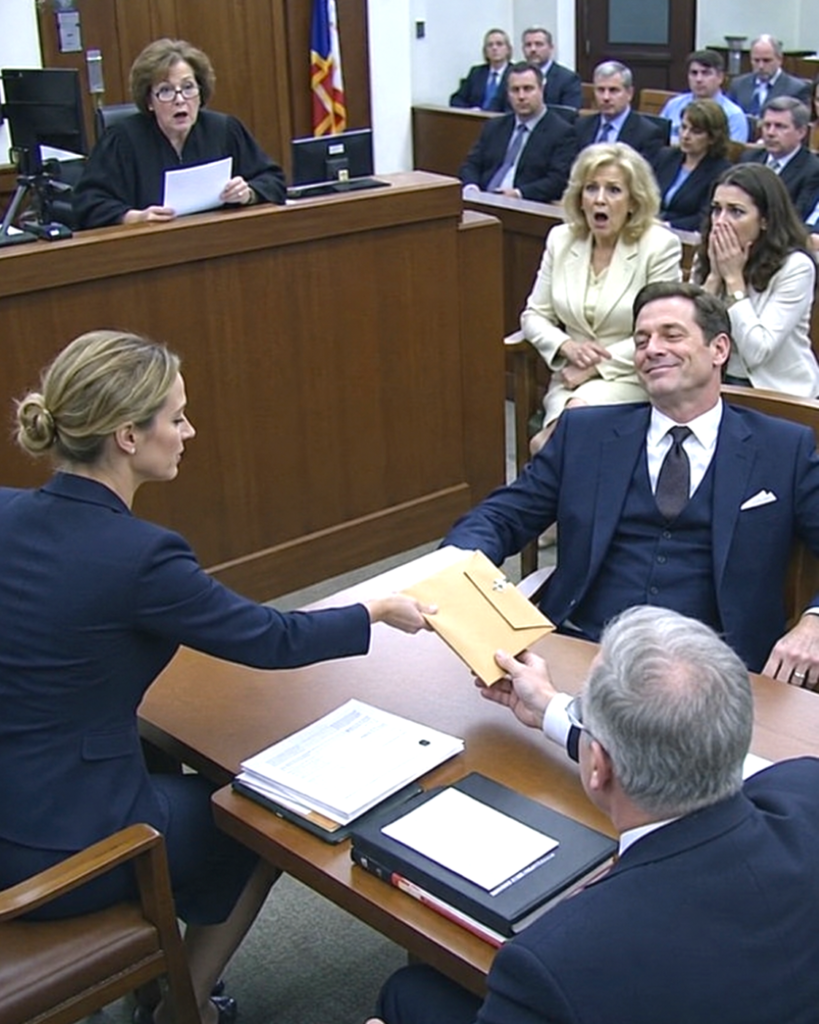
The kind of laugh designed to shrink someone in public.
It echoed through the Fulton County courtroom in Atlanta and made every head turn toward him.
Julian had always loved an audience.
He stood at the petitioner’s table in a dark navy suit that looked expensive even from across the room.
His tie was perfectly centered.
His shoes gleamed.
One hand rested on a stack of documents, the other moved casually over his jacket, like he was checking that the cameras in his mind were getting his best angle.
He looked less like a husband ending a marriage and more like a man stepping up to collect a prize.
Then he asked the judge forhalf of everything I owned.
Not half of the things we had acquired during our marriage.
Not half of shared assets to be discussed and divided under the law.
He wanted half of my company, recently valued at twelve million dollars.
He wanted half of the trust my father had left me years before I met him.
He wanted the house, the investment accounts, and even partial control over future distributions tied to family holdings he had never contributed to and legally should not have touched.
He asked for it all with a straight face.
Behind him sat my mother and younger sister, smiling.
That hurt more than Julian’s laugh.
My mother, Brenda, wore a cream suit and pearls, as though elegance could disguise opportunism.
Jasmine sat beside her in a fitted designer dress, one leg crossed over the other, pretending composure while satisfaction leaked out around the edges ofher mouth.
Next to Jasmine was her husband, Trent, wearing a watch so flashy it looked less like jewelry and more like a confession.
My own family had chosen sides.
And not quietly.
They had planted themselves behind the man trying to strip me of everything I had built, and they looked pleased to be there.
For a brief second, I thought of my father.
He would have seen it immediately.
He used to say that greed never arrives looking like greed.
It arrives dressed as concern, fairness, family, support.
It smiles while measuring your pockets.
I had not understood how right he was until after he died.
My attorney, Elias Whitmore, touched my sleeve lightly.
“Breathe,” he murmured.
I nodded.
I was breathing.
Barely.
What nobody in that room understood yet was that I had not come there unprepared.
I had spent months being underestimated.
Months listening, documenting, swallowinghumiliation, and pretending I was more broken than I was.
That morning, hidden inside a sealed brown envelope in my briefcase, was the reason I had survived those months without screaming.
It was also the reason Julian’s life was about to split open.
The marriage had not always looked like a war.
When I first met Julian, he was charming in the precise, polished way that impresses strangers quickly.
He knew how to hold eye contact just long enough.
He knew how to praise a woman without sounding rehearsed.
He knew how to make confidence look like safety.
At the time, I was building my company from nothing.
I had turned a tiny consulting operation into a fast-growing firm by sheer exhaustion and instinct.
There were months I worked until two in the morning and woke at six with strategy notes still open on my laptop.
My father used totease that I had inherited his stubbornness and my mother’s refusal to rest.
After he died, that stubbornness became survival.
Julian admired my drive—or at least he said he did.
He told people I was the smartest woman he had ever met.
He introduced me at dinners with a warmth that felt generous.
He said he was proud of me.
For a while, I believed him.
The first cracks were subtle.
He wanted access to everything in the name of partnership.
He asked detailed questions about my trust, the company’s valuation, our tax structure, my succession planning.
At first it made sense.
He was a lawyer.
He said he liked order.
He said couples who hid financial information from one another were already halfway divorced.
Then the questions became suggestions.
He suggested I add his name to certain documents for convenience.
He suggested restructuring part of the company.
He suggestedmoving some things into entities he could “better protect.” He suggested my family should be more involved because, in his words, “wealth gets unstable when one person controls all the doors.”
That line stayed with me.
Not because it sounded wise.
Because it sounded hungry.
By then my mother had started taking his side in arguments I had not even realized were arguments.
If I questioned a business recommendation, she said I was becoming controlling.
If I hesitated over money, she said marriage required trust.
Jasmine, who had spent most of our childhood resenting that I was older, steadier, and the child my father relied on, suddenly began calling Julian “the only one who tells you the truth.”
I should have understood then.
Instead, I kept trying to make peace.
That is the curse of responsible daughters.
We confuse endurance with virtue.
The affair was how the illusion finally cracked.Not even because Julian confessed.
He would never have given me that respect.
I found out by accident, though later I realized nothing in our marriage had ever really been accidental.
I was leaving my office late one Friday when I saw a message flash across an old tablet Julian had once synced to our shared home network.
He had forgotten to disconnect it.
The message was from Ava.
Jasmine’s closest friend.
Ava, who had attended our anniversary dinner two months earlier and hugged me in my kitchen.
Ava, who had called me “family.” Ava, who wrote: I miss yesterday already.
She almost suspects it.
Don’t mess this up before the filing.
Before the filing.
I read that line over and over until the words lost shape.
When Julian got home that night, I said nothing.
I watched him kiss my cheek.
Watched him ask whether I had eaten.
Watchedhim pour himself a drink and loosen his tie while his phone lit up twice in his pocket.
That was the first night I truly saw him.
I hired Elias four days later.
He did not speak much during our first meeting.
He listened.
He asked for timelines, copies of
filings, access to corporate records, trust documents, tax returns, property deeds, and bank statements.
When I finished telling him everything, including the affair, the pressure from my family, and Julian’s new insistence on rushing divorce negotiations, Elias folded his hands and said, “They are moving too fast for people who believe they are entitled.
That usually means they need you cornered before something surfaces.”
“What something?” I asked.
He held my gaze.
“That’s what we’re going to find out.”
The forensic accountant entered my life two weeks later.
Her name was Dr.
Nia Porter, and she had the unnerving calmof someone who had built a career around watching liars make arithmetic mistakes.
She started with our joint accounts, then business distributions, then a web of transfers Julian had explained away as legal retainers, tax preparation holds, consulting reserves, and temporary shielding mechanisms.
By the third week, she called me after midnight.
“Do not tell anyone we spoke tonight,” she said.
I sat up in bed.
“Why?”
“Because I found a shell company.”
The company had been registered in Georgia less than two months before Julian filed for divorce.
On paper, it was a strategic advisory firm.
In reality, it had no employees, no functioning website, and no real clients.
It did, however, have an account tied to multiple large transfers originating from sources connected to Julian, Trent, and one account that made my stomach drop when I saw it.
My mother’s.
At first I told myself there had tobe an explanation.
Then Nia found more.
Julian had been shifting money in pieces small enough not to trigger immediate internal concern, but large enough to build a separate reserve.
Some transfers came from distributions he had failed to disclose.
Others were tied to legal fees paid with marital funds and redirected through the shell company.
There was also correspondence suggesting he intended to argue that my trust had been commingled through “family support” expenditures that, according to the records, had been strategically created and documented in ways meant to manufacture confusion.
Manufacture confusion.
That was the phrase in one of the emails.
Not solve.
Not clarify.
Manufacture.
Elias told me not to react.
“Let them think you’re still shocked,” he said.
“Shock makes careless people generous with information.”
So I played the role they expected.
I let my mother call and tell me I was being unreasonable.
I letJasmine accuse me of making the divorce uglier by refusing Julian’s settlement proposal.
I let Trent deliver a speech at Sunday lunch about how successful women often sabotage their own marriages by being too suspicious.
I even let my mother reach across the table, squeeze my hand, and say, “Honey, sometimes it’s cheaper to let a man feel like he won.”
That was the day I finally stopped seeing them as misguided.
They were not trying to preserve peace.
They were trying to divide the proceeds.
The final piece came from Julian himself.
Arrogant men love to explain their brilliance when they think the listener is trapped.
A week before the hearing, he came to the house to collect more documents.
He walked around my kitchen like it already belonged to the past, opened my refrigerator without asking, and spoke to me with the condescending patience people reserve for children.
