
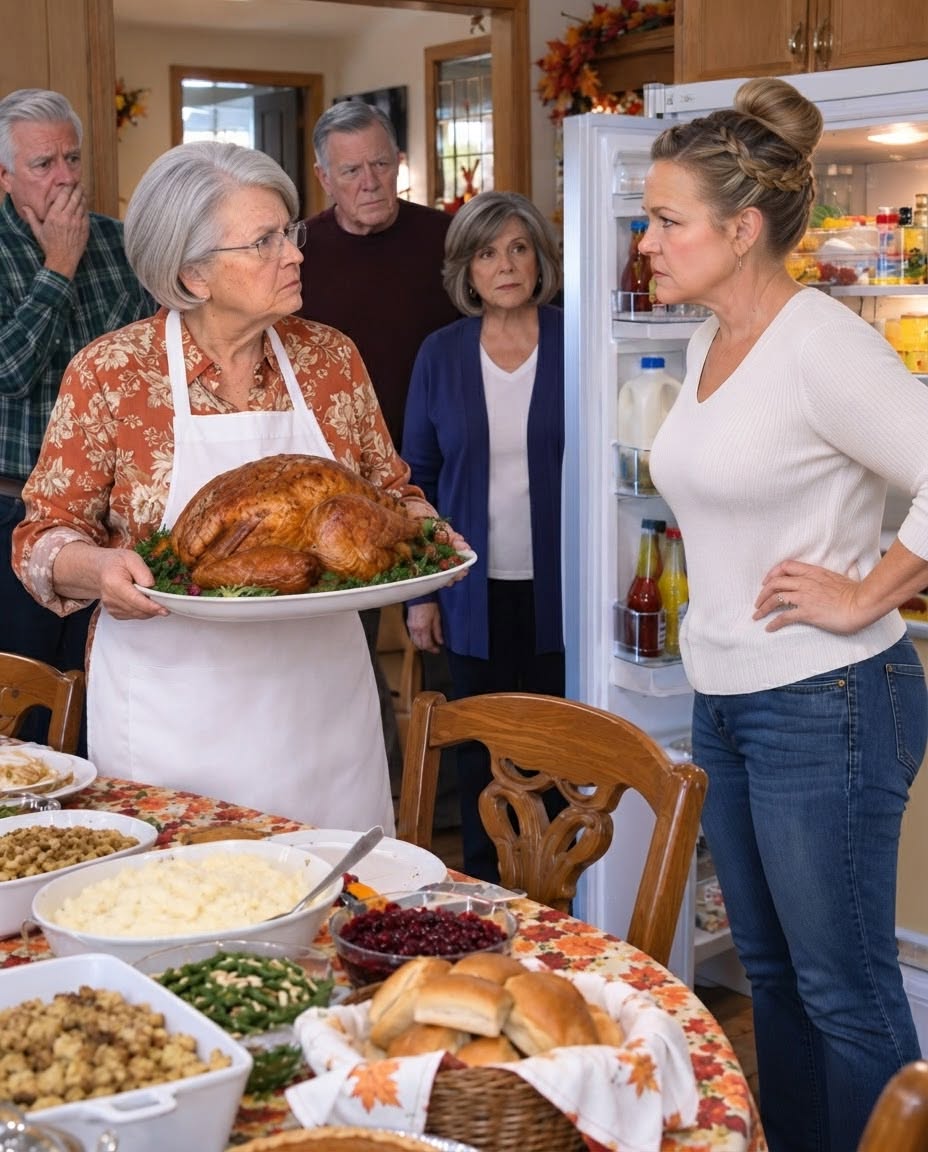
I didn’t raise my voice. I didn’t demand an apology.
Instead, I quietly lifted my twelve-pound honey-glazed ham from the kitchen counter, carried it to my car, secured it with the passenger seat belt, and drove home.
Christa probably assumed I was just a sensitive older woman who would calm down and forget everything.
What she didn’t know was that, before the evening ended, I would make three financial decisions that would change our relationship forever.
And when she showed up at my doorstep days later, furious about the money she’d lost, she discovered something else.
Her spare key no longer opened my front door.
My name is Dorothy Hale. I’m sixty-three years old, retired, and until recently, I believed that keeping my family happy meant giving them whatever they needed.
I raised my only son, Owen, by myself after his father walked out when Owen was nine.
For thirty-one years, I worked hard, saved carefully, and eventually paid off my little house.
Everything I did was motivated by one simple hope: that my son would have an easier life than I had.
When Owen married Christa six years ago, I welcomed her into our family with open arms.
I imagined holidays together, Sunday dinners, and a close relationship with the woman my son loved.
Unfortunately, things didn’t turn out that way.
Over time, I became the person they remembered when bills needed paying, childcare arrangements fell through, or something expensive needed replacing.
But when celebrations came around, I was frequently an afterthought.
Still, I told myself that helping them was simply what a loving mother did.
Then came that Sunday dinner.
Earlier in the week, Owen called with a request.
“Mom, could you make your famous honey-garlic ham this weekend? Christa’s parents are visiting, and she keeps telling them how amazing it is.”
I was delighted.
Finally, I thought, an opportunity to spend a lovely evening together.
I purchased a beautiful twelve-pound ham, mixed my special glaze, and spent hours preparing everything.
I also made a large tray of scalloped potatoes because they were my granddaughter Maya’s favorite.
By Sunday afternoon, my kitchen smelled wonderful.
I carefully packed the food into containers, loaded everything into my car, and drove forty minutes to Owen’s house.
When I arrived, the dining room was beautifully decorated.
A spotless white tablecloth covered the table. Fresh flowers stood in a crystal vase, and the finest dinnerware had been arranged neatly.
Christa’s parents, Gerald and Elaine, were seated in the living room, chatting comfortably.
I carried the heavy roasting pan into the kitchen.
“Everything smells incredible!” Christa exclaimed.
For a moment, I felt appreciated.
Then I began counting the place settings.
One for Owen.
One for Christa.
Two for her parents.
And one for Maya.
Five plates.
There were six people in the house, including me.
I assumed someone had forgotten an extra setting.
“Christa, sweetheart, should I bring another plate?”
She barely looked up.
“Oh, Dorothy, you won’t need one.”
I paused.
“What do you mean?”
She gestured casually toward the refrigerator.
“There are leftovers in there. You can have those. Tonight’s dinner is really for my parents.”
I thought I’d misunderstood.
“You’re asking me to eat separately?”
Christa gave an impatient sigh.
“My parents came a long way, Dorothy. We’re trying to make the evening special for them.”
I turned toward Owen.
My son stood beside the kitchen doorway.
He heard every word.
But instead of speaking, he lowered his eyes.
That silence hurt more than Christa’s remark.
I opened the refrigerator.
Inside were half-finished takeout containers, leftover pasta, and a small package of cheese.
I stared at the shelves.
I’d spent nearly two days preparing a meal that I wasn’t welcome to share.
And somehow, my own son thought that was acceptable.
I closed the refrigerator gently.
“Alright,” I said. “Now I understand.”
Christa smiled, apparently relieved that I wasn’t making a fuss.
She returned to the dining room.
I picked up my ham.
The roasting pan was still warm, so I wrapped it securely with a kitchen towel.
Then I walked through the front door, carried it to my car, and placed it on the passenger seat.
I even fastened the seat belt around it so the pan wouldn’t slide.
It was an absurd sight.
A sixty-three-year-old woman driving home with a twelve-pound ham buckled into the passenger seat.
But somehow, I felt lighter than I had in years.
My phone buzzed before I reached the highway.
It was Owen.
Mom, where did you go? Christa’s parents are waiting for the ham.
I pulled into a parking area and read the message.
Not a word about my feelings.
Not a question about why I’d left.
Just concern that dinner had been disrupted.
I put my phone away.
During the forty-minute drive, memories began returning.
The groceries I’d purchased whenever their budget was tight.
The birthday parties I’d helped organize.
The family vacations I’d contributed to.
The $1,400 cottage rental I’d paid for the previous summer.
Owen’s car insurance.
His phone bill, which I’d been covering since he was twenty-two.
Christa’s phone bill, too.
And the $400 I transferred every month to help with Maya’s expenses.
I had never kept track of these things because I wanted repayment.
I’d done them out of love.
But somewhere along the way, my generosity had stopped being appreciated and started being treated like an obligation.
When I arrived home, I put the ham back into the oven to keep warm.
Then I poured myself a small glass of wine, sat at my desk, and opened my laptop.
For the first time in years, I reviewed my finances with my own future in mind.
I made three decisions that evening.
First, I contacted our mobile provider to arrange for Owen and Christa’s lines to be transferred to their own billing responsibility, with proper advance notice.
Second, I spoke with my insurance representative about removing Owen’s vehicle from my policy when its coverage period ended. I made sure he would have time to arrange replacement insurance.
Third, I canceled the automatic $400 monthly transfer.
That last decision was the hardest.
Maya was my granddaughter, and I adored her.
I would never refuse to buy her school supplies, treat her to an outing, or help with something she genuinely needed.
But I had finally realized that supporting my granddaughter didn’t require sending an unlimited stream of money to two employed adults.
I wasn’t trying to punish anyone.
I was simply taking responsibility for my retirement.
A few days later, Owen called.
“Mom, did you change something with our phone account?”
“Yes, dear.”
“Christa says we’re going to have to pay about $240 every month now.”
“That’s right.”
He sounded bewildered.
“And what about my car insurance?”
“The current coverage will remain until the renewal date. After that, you’ll need your own policy.”
There was a long silence.
“But Mom, you’ve always handled those things.”
“I know, Owen. And now you’re old enough to handle them yourself.”
He exhaled.
“Is this about what happened on Sunday?”
I looked out my kitchen window.
“Sunday made me think about a lot of things.”
He hesitated.
“Christa says she’s sorry things got awkward.”
“Does she understand why I was hurt?”
Another pause.
“She just wanted her parents to have a special dinner.”
“And where did that leave me?”
Owen didn’t answer.
That silence told me the conversation wasn’t finished.
Several days later, I was working in my garden when Christa’s white SUV pulled into my driveway.
She climbed out and marched toward my front porch.
Without knocking, she took a key from her purse and tried the lock.
It didn’t turn.
She pulled it out, examined it, and tried again.
Nothing.
Then she spotted me beside the roses.
“You changed your locks!”
I stood up and brushed the soil from my gardening gloves.
“Yes, I did.”
“Without telling us?”
“It’s my home, Christa. The spare key was part of an old arrangement, and I’ve decided to end it.”
She stared at me as though I’d said something outrageous.
“Owen told me what you’ve done with our bills.”
“I assumed he would.”
“You stopped the monthly transfers, too!”
“Yes.”
Her face tightened.
“Are you seriously going to take financial support away from your own family just because dinner didn’t go the way you wanted?”
I studied her expression.
She wasn’t asking whether I’d been hurt.
She wasn’t apologizing.
She was angry because the money was gone.
“Christa,” I replied, “I spent two days preparing that meal. I bought the ingredients, cooked everything, and drove forty minutes to bring it to your home. Then you told me to eat old leftovers while everyone else enjoyed my cooking.”
“My parents were important guests!”
I nodded.
“Yes. And I was family.”
She looked away.
I continued quietly.
“I didn’t ask for special treatment. I only expected a seat at the table.”
Christa folded her arms.
“If this is about us not spending enough time with you, we can talk about it. But cutting off our financial help isn’t going to make Owen and me visit more often.”
For a moment, neither of us spoke.
Her words revealed something I’d been afraid to acknowledge for years.
She seemed to think that my financial contributions were the price of remaining welcome in my son’s life.
Once, that possibility would have terrified me.
I might have apologized, restored the payments, and pretended nothing had happened.
But not anymore.
I gave her a small smile.
“Then perhaps it’s time we all learned to live differently.”
She blinked.
“What is that supposed to mean?”
“It means I love my family, Christa. But I don’t have to finance your household to prove it.”
She opened her mouth, then closed it again.
I picked up my gardening basket.
“I’m going inside now. I hope you have a pleasant afternoon.”
As I walked toward my front door, Christa remained beside her SUV, speechless.
For the first time since Owen married her, I wasn’t begging for kindness, explaining away disrespect, or offering money to keep the peace.
I’d finally understood something important.
Being generous doesn’t mean giving people unlimited access to your wallet, your home, or your peace of mind.
I thought that was the end of the matter.
But three weeks later, Owen appeared at my house alone.
He looked exhausted, and in his hands was a small envelope.
“Mom,” he said, his voice trembling slightly, “there’s something I should have told you years ago.”
I stepped aside to let him in.
Then he placed the envelope on my kitchen table.
And when I saw what was written inside, I realized that the Sunday dinner had only exposed a small part of a much bigger family secret…
