
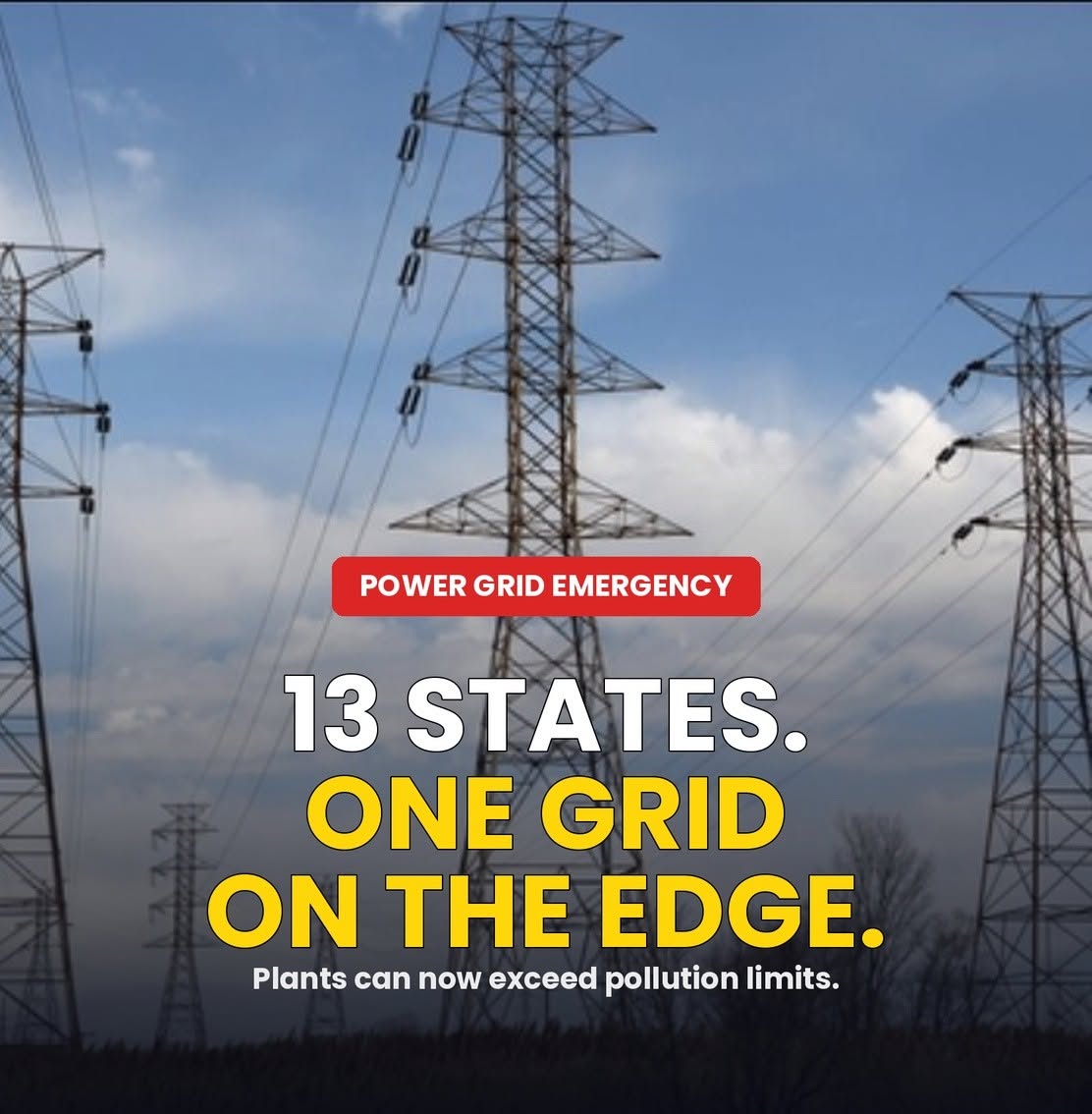
The Department of Energy has issued an emergency order for PJM Interconnection, the largest grid operator in the US, as unusually hot weather strains electricity supply from the Mid-Atlantic to the Midwest. The order lets power plants run past their normal pollution limits and gives PJM extra tools to keep the lights on.
The order at a glance
The order, DOE Order No. 202-26-50, was issued on October 12 under section 202(c) of the Federal Power Act. It took effect October 13 and runs through October 16. It covers all or parts of Delaware, Illinois, Indiana, Kentucky, Maryland, Michigan, New Jersey, North Carolina, Ohio, Pennsylvania, Tennessee, Virginia and West Virginia, as well as Washington, D.C.
PJM filed its request on October 11. It warned that without federal action, “an imminent electric reliability emergency” would threaten transmission reliability and its ability to serve customers, citing a shortage of electric energy, a shortage of generating facilities and other causes.
Who is PJM, and why does it matter?
PJM coordinates the movement of wholesale electricity across a wide swath of the eastern US. It does not own most of the power plants. Instead, it directs when and where generation runs so that supply matches demand every moment of the day. Estimates of its reach vary: one industry explainer puts its capacity at enough to power 35 to 45 million homes, while other figures suggest it serves more than 65 million people. Either way, a strain on PJM is a strain on a large share of the country’s population.
What section 202(c) does
Section 202(c) of the Federal Power Act gives the Energy Secretary authority to order temporary measures during an emergency, including keeping generation available that might otherwise be restricted. Here, it lets PJM and generation owners operate in ways that environmental permits would normally prohibit, but only as a last resort and only if needed to maintain reliability.
What the order allows
Exceeding pollution limits. Power plants can run above their usual environmental limits if that is what it takes to keep supply flowing. Critics of such orders often point to the added air pollution, while supporters argue the alternative, rolling outages, carries its own serious risks.
Using backup generation. If PJM reaches an Energy Emergency Alert (EEA) 3, the point at which electricity supply is critically low, it can direct its members to run backup generators. The order also lets PJM act as a last resort before an EEA 3 is declared.
Maximum Generation Alerts. PJM can notify transmission and generation owners that the system needs maximum output. Those owners can then decide whether to defer or cancel planned maintenance and other services that would take capacity offline.
What happens next
The order sits alongside a PJM Capacity Advisory, which can be issued up to five days in advance. It signals that PJM expects to take specific steps during the period:
- Recall or reschedule generation and transmission maintenance outages
- Notify neighboring grids to prepare for reduced imports from PJM
- Ask members to update information on generator availability, fuel supply concerns and environmental constraints
PJM’s forecast electricity demand, or load, for the affected period:
| Day | Forecast load |
|---|---|
| Monday | 103,125 MW |
| Tuesday | 112,447 MW |
| Wednesday | 112,282 MW |
Demand peaking in the 112,000 MW range is high for a mid-October week, a time of year when grids typically see a lull between summer cooling and winter heating. That is part of why the heat has caught operators off guard.
Do customers need to do anything?
No. None of the advisories ask households or businesses to change their electricity use. PJM is managing tight supply conditions across its region, and customers are simply waiting to see whether conditions ease.
What officials are saying
Energy Secretary Chris Wright said the order “will help ensure millions of American families and businesses across the mid-Atlantic have access to affordable, reliable and secure electricity” by making additional generation, including backup power, available as needed. He added that the DOE is committed to using “every available tool to prevent blackouts.”
