
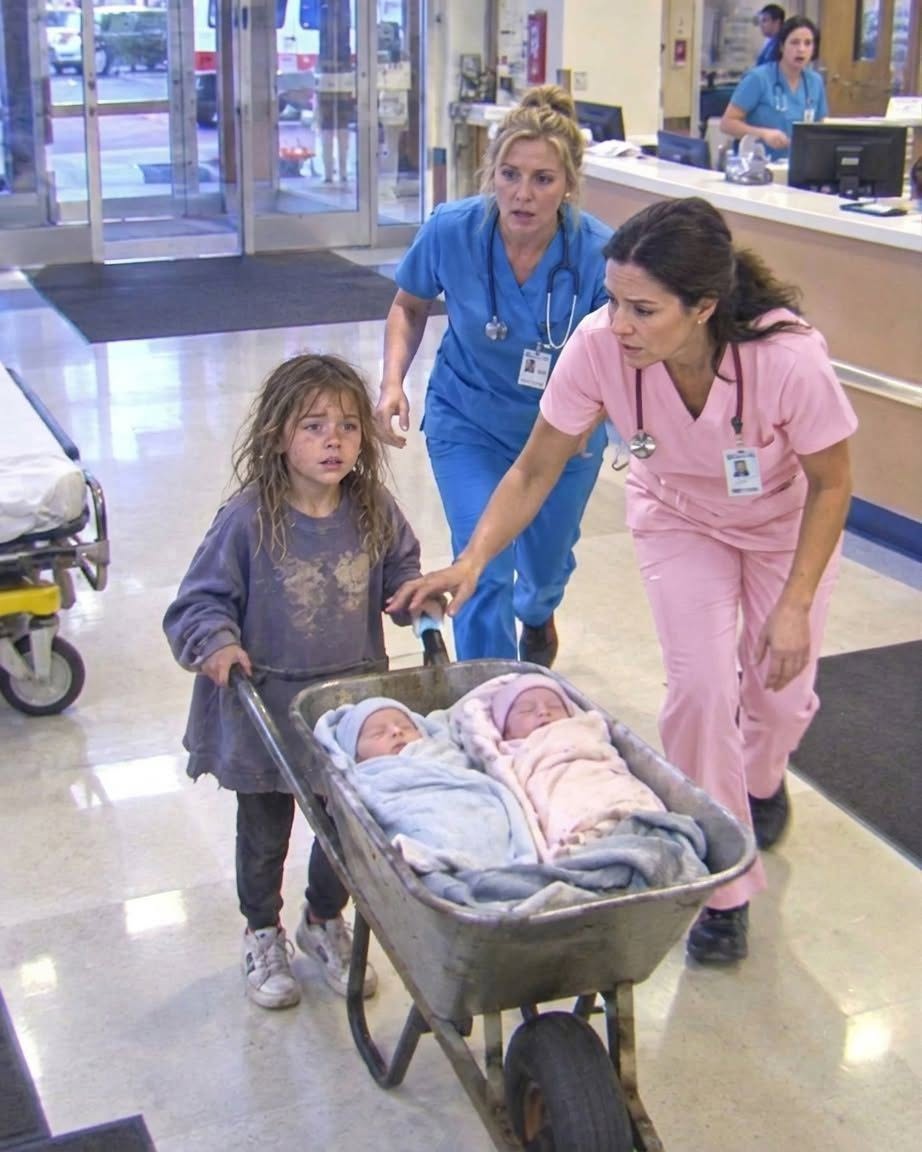
A Six-Year-Old’s Simple Wheelbarrow Trip Revealed a Crisis No One in the Family Knew About—And What His Parents Discovered That Day Changed Everything They Thought They Knew
The first line stopped the responder cold. He glanced at his partner, lifted the radio from his shoulder, and reported what the mother had written before either of them tried to guess what it meant.
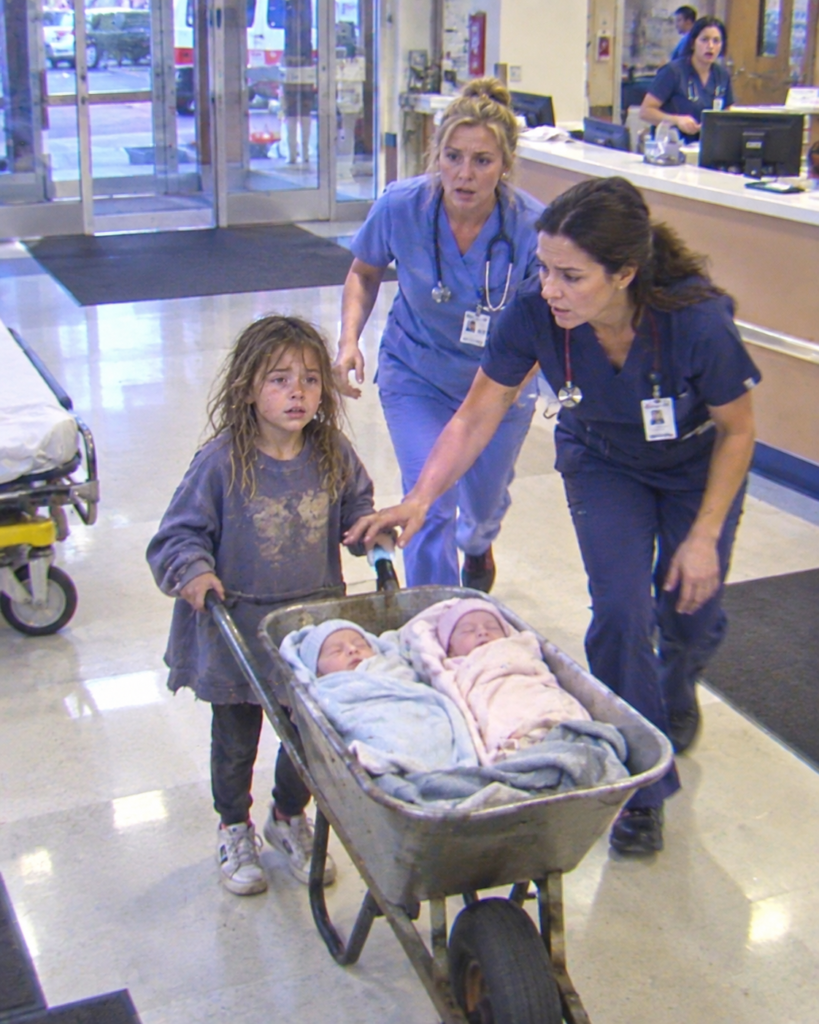
The note began with five words that changed the shape of the emergency: “I’ve been blacking out again.”
Below that, in uneven handwriting, the mother had written that the twins’ papers were in the diaper bag, that the house key stayed with her oldest child, and that if she could not wake up, the babies needed help first.
The final line was simpler.
“Please keep them together.”
The responder read it twice.
Until then, they had known only what the six-year-old girl had been able to explain: Mommy had been sleeping for three days, the babies were getting quieter, and there was nobody else in the house.
Now they knew the mother had realized something was wrong before she collapsed beside the bed.
She had tried to leave instructions.
She just had not stayed conscious long enough to use them herself.
The crew radioed the new information ahead while they continued treating her. One responder found the diaper bag exactly where the note said it would be. Inside were ordinary newborn supplies and the papers that helped confirm who the babies were and that the woman on the floor was their mother.
Nothing in the room looked like someone had planned to disappear.
A half-finished cup of water sat nearby. Laundry was waiting in a basket. Newborn blankets were folded on a chair. A few groceries were still on the kitchen counter.
It looked like a home where somebody had expected to get up again in a few minutes.
She simply hadn’t.
When the ambulance finally pulled away from the house, the little key the girl had surrendered at the emergency room was still with the paramedic who had opened the door.
He kept it carefully separated from the rest of his equipment.Back at the hospital, the girl had moved her chair as close as the nurses would allow to the hallway leading toward the twins.
She had accepted water after one nurse promised that nobody was going to forget her mother.
Food was harder.
A sandwich sat unopened beside her while she watched every pair of scrubs passing the doorway.
Whenever someone came through quickly, she straightened.
Whenever they kept walking, she settled back again.
One nurse finally crouched beside her and asked whether her hands hurt.
The girl looked down as though she had forgotten she had hands.
Her palms were red from gripping the wheelbarrow handles for miles.
“A little,” she admitted.
The nurse brought a cool cloth and wrapped it gently around one palm, then the other.
The girl allowed it for less than a minute before asking the same question again.
“Did they find Mommy?”
“They found her.”
“Is she coming?”
“Yes.”
The answer changed the girl’s entire posture.
Not dramatically. She did not cheer or burst into tears.
She simply leaned back against the chair for the first time since she had arrived.
Minutes later, the sound of an incoming ambulance carried through the emergency department.
The girl stood so quickly that the unopened sandwich slid from her lap.
A nurse caught it before it hit the floor.
“Is that her?”
Nobody wanted to promise something they could not yet confirm.
Then the paramedic who had borrowed the key appeared at the far end of the hall.
He was walking now instead of running.
The girl recognized him immediately.
Her eyes dropped to his hand.
He understood what she was looking for.
The paramedic reached into a secure pocket and took out the small house key on its piece of string.
“We brought your mom,” he told her. “And I brought this back too.”
She took the string with both hands.
“Did it work?”
“It worked.”
She put the key around her neck again.
Then she asked the question nobody in the hallway was prepared for.
“Did Mommy wake up?”
Not yet.
The medical team was already treating her, and the doctors were concerned that a serious complication after childbirth had worsened while she went without fluids and proper care.The important thing, one nurse explained carefully, was that her mother was alive and was finally where people could help her.
The girl nodded.
She understood “alive.”
That was enough for the moment.
The twins were being treated too.
One had arrived weaker than the other, which matched what the girl had noticed at home when one baby became frighteningly quiet.
Both needed close monitoring, warmth, fluids, and feeding support, but the early updates were cautiously encouraging.
The staff kept them near each other whenever care allowed, just as the girl had requested and just as the mother’s note had asked.
When a nurse told her that, the six-year-old stared at the floor for several seconds.
“Mommy wrote that?”
“She did.”
“Before she went to sleep?”
The nurse chose her words carefully.
“Before she got too sick to wake up.”
That distinction mattered.
For three days, the girl had believed her mother was sleeping in a way she could not understand.
She had tried water.
She had tried cereal.
She had shaken her shoulder.
She had stayed close because children are taught not to leave home alone, not because she understood that waiting could become dangerous.
When one twin became too quiet, that rule finally lost to another instinct.
Get help.
The hospital staff gradually learned how she had managed the days inside the house.
She had stayed near the babies because that was what she had seen her mother do.
She had used the supplies she recognized and tried to copy the small routines she remembered.
When she became hungry, she ate what she could reach without using the stove.
At night, she stayed close enough to hear the twins.
She checked on her mother over and over.
The details did not make the adults admire the situation.
They made it harder to hear.
A six-year-old should not have needed to decide whether a newborn was breathing normally.
She should not have needed to calculate whether she could push two babies down a road by herself.
She should not have needed to remember which turns led toward a hospital.But she had.
And when the moment came, she moved.
That afternoon, a hospital social worker met with the medical team and began arranging what would happen if the mother needed to remain hospitalized.
The conversation was practical rather than dramatic.
Who could safely stay with the girl?
Who could help once the babies were ready to leave?
Was there a relative, friend, neighbor, or other trusted adult the mother normally relied on?
The girl knew people by first names and relationships, not phone numbers.
She knew who sometimes brought groceries.
She knew which person her mother called when something broke.
She knew there was an aunt who lived far enough away that visits were special.
Piece by piece, with information from the mother’s papers and phone once it was located, the adults began building a safe plan.
Nobody asked the six-year-old to solve another problem.
For the first time in three days, the next decision belonged to grown-ups.
Late that evening, the girl was allowed to see her mother from the doorway while a nurse stayed beside her.
The woman looked smaller in the hospital bed than she had on the floor at home.
There were tubes, blankets, monitors, and people checking things the girl did not understand.
She did understand one thing.
Her mother’s chest was moving.
The girl watched it rise.
Then fall.
Then rise again.
“She’s breathing,” she whispered.
“Yes,” the nurse said.
The girl stood there for a little longer before turning away.
She did not ask to touch anything.
She did not ask the nurse to wake her.
She had spent three days trying to do that herself.
Now she let the hospital try.
The next morning brought the first major change.
The mother opened her eyes.
At first she could answer only simple questions.
She knew she was in a hospital. She knew she had newborn twins. She knew she had an older daughter waiting somewhere nearby.
What she did not understand was how much time had passed.
When a clinician told her, she stared at him.
“Three days?”
Her voice was barely audible.Then her eyes widened.
“The babies.”
He told her they were alive and receiving care.
She tried to sit up.
The effort lasted only a second before the staff stopped her.
“My daughter?”
“She’s safe too.”
That was when the mother began crying.
Quietly at first.
Not because she had heard bad news.
Because she had finally heard enough good news to understand what could have happened.
The six-year-old was brought in after the staff agreed her mother was stable enough for a short visit.
The girl entered slowly.
For all the urgency she had shown when pushing the wheelbarrow, she suddenly seemed unsure of what she was allowed to do.
Her mother lifted one hand from the blanket.
That was permission enough.
The girl crossed the room and pressed herself carefully against the side of the bed.
Her mother touched the back of her sweatshirt.
Neither of them spoke for several seconds.
Then the child pulled back.
“I took the babies.”
Her mother looked confused.
“Where?”
“Here.”
The mother stared at her.
A nurse standing nearby explained the rest in the fewest words possible.
The wheelbarrow.
The walk.
The emergency room.
The key.
By the time she finished, the mother’s hand was covering her mouth.
“You pushed them here?”
The girl nodded.
Then came the fear she had apparently been carrying since the ambulance arrived.
“Are you mad?”
Her mother immediately shook her head.
“No.”
“I left the house.”
“I know.”
“You said I wasn’t supposed to.”
The mother’s expression tightened.
There are moments when a rule that once made perfect sense becomes completely useless in the face of something larger.
She reached for her daughter’s hand.
“You were supposed to get help if you were in danger.”
The girl looked at her carefully.
“We were?”
“Yes.”
“All of us?”
“All of you.”
The answer seemed to settle something that the child had not known how to ask.
Then she touched the key hanging against her sweatshirt.
“He gave it back.”
Her mother looked at the string and closed her eyes for a moment.
