
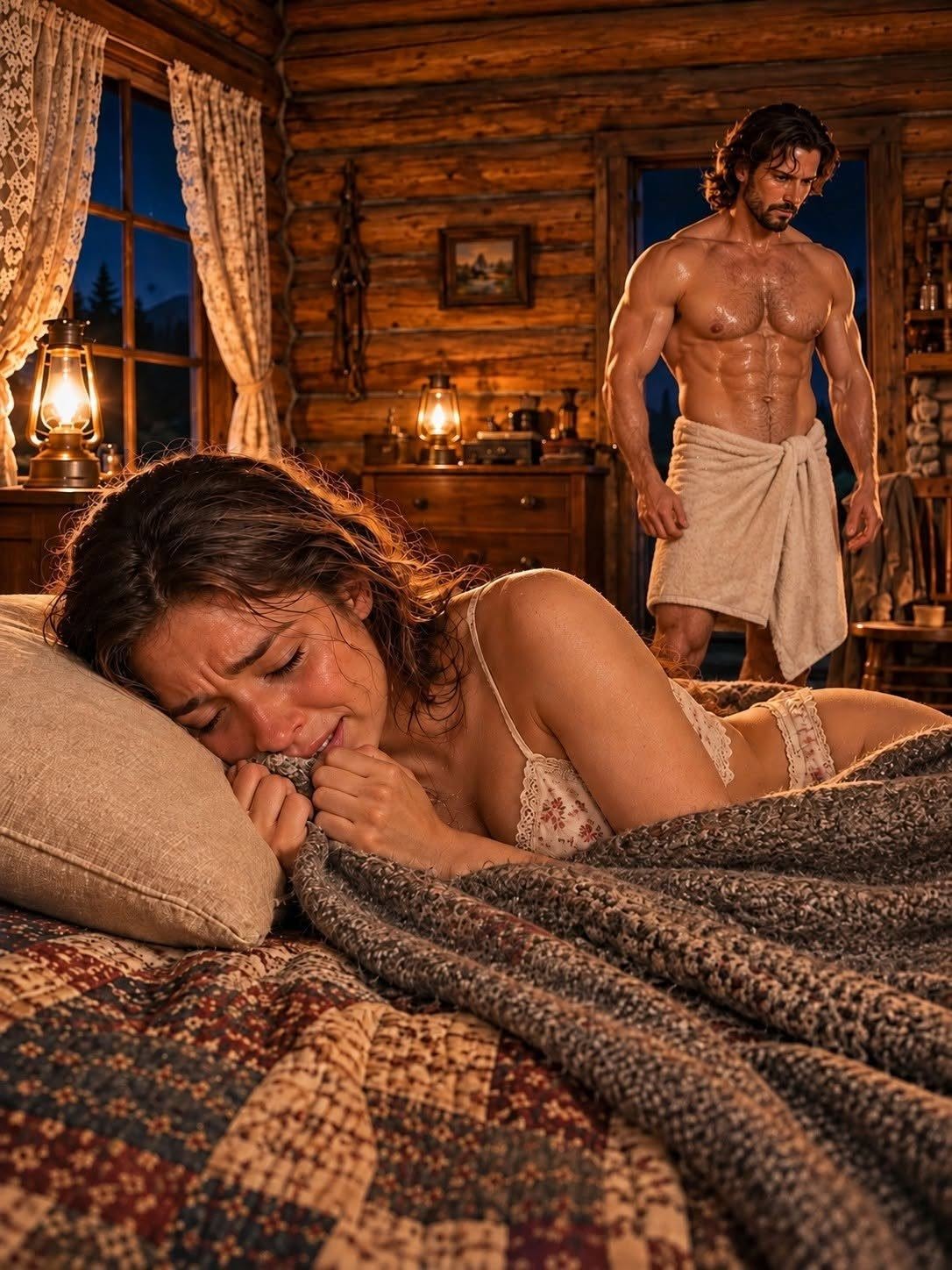
When Caleb placed the ring on Clara’s finger, she whispered, “I hope neither of us regrets this.”
His hand remained around hers for half a second longer than necessary.
“So do I,” he said.
The preacher smiled as though he had witnessed a declaration of love.
Clara knew better.
This was an arrangement.
A practical solution to a practical danger.
At least, that was what she kept telling herself.
By sunset, they were riding toward Caleb’s ranch beneath a sky streaked with copper and pale violet. The Wyoming wind moved across the grass in long waves, bending the dry stalks until the whole prairie seemed to breathe.
Clara rode beside him in silence.Caleb had offered to let her remain at her own homestead, but after the barn fire and the poisoning of her horse, neither of them believed that would be wise.
“You’ll have your own room,” he had told her earlier.
She had stared at him.
“On our wedding night?”
His expression had barely changed.
“I thought you might prefer it.”
She had almost laughed.
Instead, something in her chest had tightened.
It was the first sign that perhaps Caleb Mercer understood loneliness better than anyone she had ever met.
His ranch house was larger than Clara’s cabin but far from grand. Two bedrooms stood on opposite ends of a narrow hall, with a kitchen, a sitting room, and a stone fireplace that showed years of use. Everything was orderly.
Too orderly.
Nothing seemed touched unless it served a purpose.
A pair of boots beside the door.
A rifle over the mantel.
A Bible on a small table.
Three tin cups hanging from hooks near the stove.
Clara noticed the third cup immediately.Caleb saw her looking at it.
He reached past her and took it down.
“Forgot that was there.”
He placed it inside a cupboard.
Clara did not ask.
Not then.
She removed her gloves.
“What should I do?”
Caleb looked genuinely puzzled.
“Do?”
“I assume the house doesn’t run itself.”
“It mostly has.”
“That explains the state of your curtains.”
He glanced toward the windows.
“There’s something wrong with them?”
Clara smiled for the first time all day.
“You’re a brave man, Mr. Mercer.”
His mouth almost moved.Almost.
“Caleb.”
She looked at him.
“If we’re married, you might as well call me Caleb.”
“All right.”
He waited.
Clara understood.
“And you may call me Clara.”
His gaze softened.
“Thank you.”
For some reason, that quiet gratitude unsettled her more than flirtation would have.
That night, Clara lay awake in the guest room listening to the unfamiliar sounds of the ranch.
The creak of timber.
The low moan of wind against the walls.
The occasional movement of cattle outside.
And once, long after midnight, the careful footsteps of Caleb walking down the hallway.
They stopped outside her door.
Clara held her breath.
He did not knock.
After several seconds, the footsteps moved away.
She heard the front door open.
Then close.
Curiosity pulled her from bed.
Through the window, Clara saw Caleb crossing the yard alone.
Moonlight silvered his shoulders.
He walked toward a rise beyond the barn and disappeared.
The next morning, she found him repairing a section of fence as though he had slept perfectly well.
She said nothing.For the next two weeks, they learned how to be married without behaving like husband and wife.
Caleb rose before dawn.
Clara rose shortly after.
They ate breakfast together.
They disagreed about coffee.
His was strong enough, Clara claimed, to remove paint from a wagon.
Hers, Caleb said, might be mistaken for warm water.
She reorganized the kitchen.
He moved everything back.
She reorganized it again.
The third time, he surrendered.
Little by little, the house changed.
A jar of wildflowers appeared on the table.
Fresh bread cooled on the windowsill.
Clara stitched the torn curtain Caleb had apparently failed to notice for three years.
In return, he repaired the loose boards on her homestead, installed a stronger lock, and quietly began riding the perimeter every evening.
Neither mentioned affection.
But affection entered anyway.
It was there when Caleb brought her a smooth blue stone because she had once said it reminded her of her mother’s eyes.
It was there when Clara saved the last piece of apple pie because she noticed he always pretended he did not want dessert, then looked disappointed when none remained.
It was there on the afternoon she found him asleep in a chair after three days of spring calving and draped a blanket across his shoulders.
And it was there when Caleb awakened, saw the blanket, and sat for a long time without moving.
Still, part of him remained somewhere Clara could not reach.
Every Sunday, he rode alone toward the ridge behind the north pasture.
Every Sunday, he returned quieter.
One evening, while cleaning the sitting room, Clara discoShe did not open it.
She did not even try.
But carved into the lid were two letters.
E.M.
When Caleb returned, he saw the box sitting exactly where she had found it.
His face changed.
Not anger.
Pain.
“I wasn’t snooping,” Clara said.
“I know.”
“I only moved it to sweep.”
He crouched and picked it up.
For a moment his thumb traced the initials.
“Your first wife?”
Caleb nodded.
Clara waited.
When no explanation came, she turned away.
“Her name was Eleanor.”
Clara looked back.
Caleb sat down slowly.
“She died eight years ago.”
“I’m sorry.”
His jaw tightened.
“I was supposed to meet her in town that day.”
Clara remained silent.
“There was a storm coming. I told her not to travel alone. She went anyway.”
“What happened?”
“Her wagon overturned at the river crossing.”
Clara’s heart sank.
“Caleb…”
“I found the wagon.”
His voice had become distant.
“Not her.”
Clara frowned.
“You never found her?”
He shook his head.
“The river was high. Everyone told me there was no chance.”
“But you searched.”
“For weeks.”
He looked toward the window.
“Then months.”
“What was in the box?”
“Her things.”
He stood.
The conversation was over.
Yet one sentence stayed with Clara long after he had left the room.
He had not said Eleanor was buried.
He had said she was never found.
Three days later, solay Silas Boon came to the ranch.
Caleb was in the far pasture.
Clara saw Silas approaching and stepped onto the porch before he could knock.
He removed his hat.
“Mrs. Mercer.”
The name sounded strange in his mouth.
“What do you want?”
Silas looked toward the barn.
“Congratulations on your marriage.”
“Thank you.”
“You work quickly.”
Clara folded her arms.“If you came to discuss my land, you can leave.”
“I came to warn you.”
Her expression sharpened.
“About what?”
Silas sighed.
“Mercer.”
Clara almost laughed.
“You expect me to believe you’re concerned for me?”
“I expect nothing.”
He stepped closer, stopping at the foot of the porch.
“Did he tell you why he offered to marry you?”
“Yes.”
“To protect your land?”
“Yes.”
Silas studied her.
“And you believed him.”
Clara felt irritation rise.
“Leave.”
“You should ask him about the railroad survey.”
Her hand tightened against her sleeve.
“What about it?”
Silas replaced his hat.
“Ask your husband.”
“That isn’t an answer.”
“No.”
Silas glanced toward the distant pasture.
“It’s a question.”
Then he walked away.
Caleb returned just before dusk.
Clara waited until supper.
“Silas Boon came here.”
Caleb’s fork stopped.
“What did he want?”
“To cause trouble.”
“That sounds like Boon.”
“He told me to ask you about the railroad survey.”
Caleb put his fork down.The silence that followed was answer enough.
Clara’s stomach dropped.
“You knew.”
“Clara—”
“You knew about the railroad before you proposed.”
“Yes.”
“How long?”
“Several months.”
She stood.
“You told me Boon wanted my land because of the railroad.”
“I did.”
“You did not tell me you knew before he started threatening me.”
Caleb looked up sharply.
“I didn’t know he was threatening you.”
“But you knew the land would become valuable.”
“Yes.”
“And then you married me.”
His expression hardened.
“Those two things have nothing to do with each other.”
“How am I supposed to know that?”
“Because I’m telling you.”
Clara laughed once, bitterly.
“That is exactly what Silas would say.”
Caleb stood so quickly that his chair scraped against the floor.
“I am not Silas Boon.”
“No.”
She looked directly at him.
“But I don’t know what you are.”
The words landed between them.
Caleb went still.
Clara regretted them immediately.
But neither apologized.
After a moment he walked from the house.
He did not return that night.
At dawn, Clara found a folded document beneath her coffee cup.
It was a deed.
Her deed.
Along with another document.
She read it twice before understanding.
Caleb had legally signed away any marital claim he might have had to Clara’s property.
Regardless of their marriage, regardless of the railroad, regardless of how valuable the land became, the forty acres belonged solely to her.
A note lay beneath it.
I should have told you everything before I asked you to trust me.
You deserved better than half the truth.
— Caleb
Clara closed her eyes.
When he returned that afternoon, mud on his boots and exhaustion beneath his eyes, she met him at the barn.
“I found the papers.”
He nodded.
“Why didn’t you show me before?”
“I should have.”
“That isn’t what I asked.”
He removed his gloves slowly.
“Because I didn’t want you to think I expected gratitude.”
“You could have saved us both an argument.”
“Probably.”
Clara stepped closer.
“Why did you marry me?”
“To protect you.”
“That’s the answer you keep giving.”
“It’s the truth.”
“Not all of it.”
Caleb looked away.
Clara waited.
Finally he said, “The day I found you beside that broken wagon…”
His voice faded.
“What?”
“You reminded me what it sounded like when someone still believed tomorrow mattered.”
Clara said nothing.
Caleb gave a humorless smile.
“I’d forgotten.”
Her anger disappeared so quickly it frightened her.
“You could have told me that.”
“I’m not very good at telling people things.”
“I’ve noticed.”This time, the corner of his mouth actually lifted.
Clara reached for his hand.
He stared at her fingers covering his.
Neither moved.
Then a rider appeared on the southern road.
It was Sheriff Nathan Bell.
He came with news that one of Silas Boon’s hired men had been arrested after trying to sell stolen cattle two counties east.
The man had talked.
Not enough to prove Silas had ordered the fire at Clara’s barn.
But enough to suggest Silas had been paying men to intimidate several small landowners near the proposed railroad route.
“We may finally have something we can use,” Nathan said.
Caleb looked toward Clara.
“For the first time, maybe.”
The following week brought an uneasy calm.
Silas did not return.
No fences were cut.
No animals became sick.
No anonymous warnings appeared.
For the first time in months, Clara began imagining a future larger than simply surviving the next day.
One evening she and Caleb sat on the porch watching the sun sink behind distant mountains.
“You ever think about leaving Wyoming?” Clara asked.
“No.”“That was quick.”
“I’ve been other places.”
“And?”
“I came back.”
“Why?”
Caleb considered.
“Here, when something’s far away, you can see it coming.”
Clara smiled.
“You really believe that?”
“No.”
She laughed.
The sound startled both of them.
Caleb turned toward her.
Something changed in his eyes.
Clara felt it too.
He lifted one hand, hesitated, then brushed a loose strand of hair from her cheek.
His fingers barely touched her skin.
“Clara…”A horse whinnied sharply in the barn.
Caleb’s hand dropped.
The moment vanished.
He stood.
“I’ll check.”
Clara watched him go with a strange mixture of disappointment and relief.
Inside the barn, nothing seemed wrong.
But the side door stood open.
Caleb was certain he had closed it.
He stepped inside.
A folded paper had been nailed to the stall post.
Only four words were written on it.
Ask who survived the river.
Caleb stared.
His blood turned cold.
He tore the note down before Clara could see it.
For two days, he said nothing.
Then he rode into Red Creek alone.
At the telegraph office he sent a message east to a former Pinkerton investigator he had once hired during his search for Eleanor.
VERIFY ANY RECORDS CONNECTED TO ELEANOR MERCER AFTER MAY 1876. URGENT.
The answer came the following afternoon.
NO CONFIRMED DEATH RECORD. POSSIBLE WOMAN MATCHING DESCRIPTION TREATED IN CHEYENNE JUNE 1876. RECORD INCOMPLETE. INVESTIGATING.
Caleb read the message three times.The room seemed to tilt beneath him.
Eleanor?
Alive?
After all these years?
He folded the telegram and placed it inside his coat.
He intended to tell Clara.
He truly did.
But when he reached home, he found her standing in the kitchen wearing one of his old work shirts over her dress, flour on her cheek and an expression of determination as she attempted to rescue a loaf of bread she had forgotten in the oven.
“You’re home.”
She smiled at him.
Home.
One word.
And suddenly Caleb was terrified.
Not because Eleanor might be alive.
Because Clara mattered now.
That evening, he nearly told her twice.
Both times he failed.
Three days later, the matter of Silas Boon reached a turning point.
Sheriff Bell received sworn testimony from two men connecting Silas to intimidation around the railroad route.
Silas was summoned to Red Creek to answer questions.
He did not flee.
He did not threaten anyone.
Instead, he arrived with an attorney and denied ordering any crime.
The dispute became what real disputes often became.
Messy.
Slow.
Dependent upon witnesses, paperwork, and patience.Caleb found that almost reassuring.
There would be no dramatic gunfight in the street.
No instant justice.
Only people making choices and eventually answering for them.
Yet that evening, Caleb received another message.
The investigator had found something.
A surviving medical ledger from a Cheyenne charity clinic.
A woman approximately twenty-five years old had been brought in unconscious six weeks after Eleanor disappeared.
She had suffered a head injury.
She could not remember her surname.
The ledger listed only one name.
ELLIE.
Caleb stared at the paper until the letters blurred.
He saddled his horse.
Clara found him in the barn.
“Where are you going?”
“Cheyenne.”
“Tonight?”
“Yes.”She looked toward the darkening sky.
“Why?”
Caleb tightened the saddle strap.
“There’s something I need to find out.”
“What?”
He could not look at her.
“Caleb.”
“I’ll explain when I return.”
Something in his voice frightened her.
“Is this about Silas?”
“No.”
“Then what?”
He pulled himself into the saddle.
Clara grabbed the bridle.
“You’re not leaving like this.”
“I have to.”
“No, you don’t.”
“Clara.”
“I am your wife.”The words came harder than she intended.
“You don’t get to disappear into the night whenever something hurts too much to explain.”
Caleb stared down at her.
Before he could answer, a gunshot cracked through the dark.
The horse reared.
Clara screamed.
Caleb fell from the saddle.
For one terrible second, everything became confusion.
The frightened horse.
Dust.
The echo rolling across the pasture.
Caleb landed hard, one hand gripping his side.
Clara dropped beside him.
“Caleb!”
“I’m all right.”
Blood spread across his shirt.
“No, you are not.”
“The bullet grazed me.”
“You are bleeding.”“So I noticed.”
Despite the pain, the dryness in his voice was so familiar that Clara almost cried from relief.
Sheriff Bell and two ranch hands followed tracks from the property but found no shooter.
The wound was shallow.
The bullet had cut across Caleb’s ribs without entering deeply.
The doctor stitched it and ordered rest.
By midnight, Caleb was lying in the bedroom while Clara sat beside him.
He woke to find her crying.
Not quietly.
Her face was buried in the pillow, her shoulders shaking.
Caleb pushed himself upright.
The movement pulled at his stitches.
“Clara?”
She did not answer.
He swung his feet toward the floor.
“You’re hurt,” she said.“I’ll live.”
“Don’t say that like it’s nothing.”
He froze.
Clara lifted her face.
“Do you have any idea what I thought when you fell?”
Caleb did not know what to say.
“I thought you were dead.”
“I’m sorry.”
“No.”
She wiped her face angrily.
“I don’t want an apology.”
Caleb stood.
Pain shot through his side.
“What are you doing?”
“I have to go.”
Her eyes widened.
“Go?”
“To Cheyenne.”
“Now?”
“Yes.”“Caleb Mercer, you can barely stand.”
“I’ll manage.”
He reached for his gun belt.
Clara caught his wrist.
“Please.”
Her voice broke.
“Don’t leave me.”
Caleb looked down at the blood beginning to soak through the edge of his fresh bandage.
Then he looked at her.
“I have to.”
“No. You don’t understand.”
Her eyes moved toward the blood on his shirt before returning to his face.
“I’m not crying because I married you.”
Caleb stopped.
“Then why?”
Clara’s lips trembled.“Because I thought I was going to lose you.”
Silence filled the room.
Caleb sat down slowly.
Clara looked frightened now, as though she had revealed something she had promised herself never to say.
“I know what this marriage was supposed to be,” she whispered. “I know what we agreed.”
“Clara…”
“But somewhere along the way, it stopped feeling like an arrangement.”
Caleb’s breath caught.
“When you ride away, I listen for you to come back.”
Her eyes filled again.“When you’re late, I worry.”
She laughed softly through the tears.
“And I know exactly how terrible your coffee is, and I know you pretend you don’t like pie, and I know you walk out to that ridge when something is hurting you.”
Caleb looked at her.
“I don’t know when it happened.”
She lowered her eyes.
“But I love you.”
The words seemed to remove every defense he had built.
For eight years, Caleb had believed there was a part of him that died beside that river.
Now Clara had reached into the quiet ruins and found something still living.
He touched her cheek.
“I’m afraid to say it.”
“Why?”
“Because everyone I love becomes something I can lose.”
Clara placed her hand over his.
“That isn’t a reason not to love someone.”
“For me, it has been.”
“And now?”
His thumb brushed away a tear.
“Now I’m trying to learn another way.”
Clara leaned toward him.
Their kiss was soft.
Uncertain.
Nothing like the grand kisses described in novels.
It was better.
It felt like two lonely people admitting they were no longer alone.
When they separated, Caleb rested his forehead against hers.
“I love you too.”
Clara closed her eyes.
Then she opened them.
“What is in Cheyenne?”
Caleb went still.
The moment had come.
No more half-truths.
No more silence disguised as protection.
He reached into his coat and removed the telegram.
Clara read it.
Once.
Twice.
Her face slowly changed.
“Eleanor?”
Caleb nodded.
“You think she may have survived?”
“I don’t know.”
Clara looked at him.
“If she did…”
Neither finished the sentence.
They both understood.
If Eleanor had survived, what did that make Caleb’s marriage to Clara?
What did it make the life they had begun building?
Clara folded the telegram carefully.
“You still have to go.”
Caleb stared at her.
“Not tonight.”
“No.”
She wiped her cheeks.
“Tomorrow.”
“You want me to?”
“I want the truth.”
His voice was low.
“And if the truth changes everything?”
Clara looked toward the window where dawn was beginning to touch the horizon.
“Then we face what it changes.”
The following morning, Caleb did not ride to Cheyenne alone.
Clara went with him.
Sheriff Bell insisted on accompanying them part of the way because whoever fired the shot had not been identified.
The trip took more than a day.
By the time Caleb and Clara reached the charity clinic named in the records, both were exhausted.
The clinic had changed owners twice.
Most of its old records had been moved to a county archive.
An elderly nurse named Mrs. Talbot remembered nothing personally, but she brought them a faded ledger.
“There,” she said.
Caleb saw the entry.
June 19, 1876.
Unknown female.
Approximately twenty-five.
Found outside Cheyenne.
Head trauma.
Confusion.
Called herself Ellie.
Clara stood beside him.
“What happened to her?”
Mrs. Talbot turned the page.
The final note was brief.
Released into care of Samuel Whitmore.
Clara stopped breathing.
Caleb looked at her.
Neither spoke.
The nurse frowned.
“Is something wrong?”
Clara touched the name on the page.
Samuel Whitmore.
Her father.
“My father,” she whispered.
Caleb stared at her.
“That’s impossible.”
Clara slowly shook her head.
“No.”
A childhood memory suddenly returned.
A woman staying in their home.
A woman with dark hair.
A woman who rarely spoke.
Clara had been a girl then.
Eleven years old.
She remembered her father telling her the woman was sick.
