
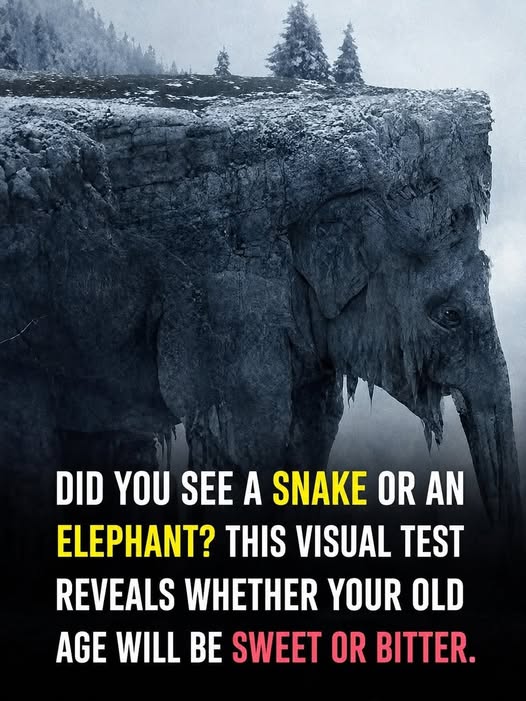
Did You See the Snake or the Elephant First? Your Answer May Surprise You Snake or Elephant? The Optical Illusion That Claims to Reveal Your Future Outlook
What you notice first in this famous illusion may reveal surprising traits.
Optical illusions have fascinated people for generations, offering a playful way to explore how our brains interpret the world around us. One image that has recently captured attention online asks a simple question: Did you see a snake or an elephant first? According to supporters of the test, your answer may reveal whether you tend to approach later life with optimism or pessimism.
While there is no scientific evidence that a single image can accurately predict a person’s future, psychologists agree that visual perception can provide interesting clues about attention, personality tendencies, and cognitive styles.
The illusion itself features what appears to be a large elephant-shaped cliff covered with snow. However, hidden within the image is another figure that some viewers immediately recognize as a snake. The object you notice first is said to reflect certain characteristics of your thinking patterns.
If You Saw the Elephant First
6
People who immediately spot the elephant are often described as practical, grounded, and focused on the bigger picture. According to interpretations of the illusion, these individuals prefer stability and long-term planning rather than acting on impulse.
Supporters of the test suggest that elephant-first viewers are likely to:
Think carefully before making important decisions.
Value family, security, and meaningful relationships.
Remain calm when facing challenges.
Approach the future with patience and confidence.
The illusion claims that such people are more likely to experience a “sweet” old age because they tend to build strong foundations throughout life. Whether or not this prediction is accurate, many personality assessments associate these qualities with resilience and emotional stability.
If You Saw the Snake First
5
Those who notice the snake before the elephant are often described as highly observant and detail-oriented. They may quickly identify subtle patterns that others overlook.
According to the popular interpretation, snake-first viewers tend to:
Pay close attention to details.
Analyze situations deeply.
Be cautious when trusting others.
Notice risks before opportunities.
While these traits can be valuable, the illusion suggests that excessive worry or overthinking may sometimes prevent such individuals from fully enjoying the present moment. The “bitter old age” prediction commonly attached to the image is intended as a symbolic warning rather than a literal forecast.
What Science Says About Optical Illusions
Experts emphasize that optical illusions do not predict the future. Instead, they demonstrate how the brain processes visual information. Different people focus on different elements depending on factors such as attention, experience, expectations, and even mood.
Researchers have long used visual puzzles to study perception, showing that our brains constantly make assumptions about what we see. These assumptions can influence how quickly we recognize shapes, faces, animals, and patterns hidden within complex images.
Rather than revealing destiny, illusions highlight the remarkable diversity of human perception.
The Real Takeaway
Whether you saw a snake or an elephant first, the image serves as a reminder that people often view the same situation from different perspectives. One person may focus on details, while another sees the broader picture. Neither approach is inherently better; both offer unique strengths.
So, what did you see first? The answer may not predict your future, but it could spark an interesting conversation about how your mind works.
